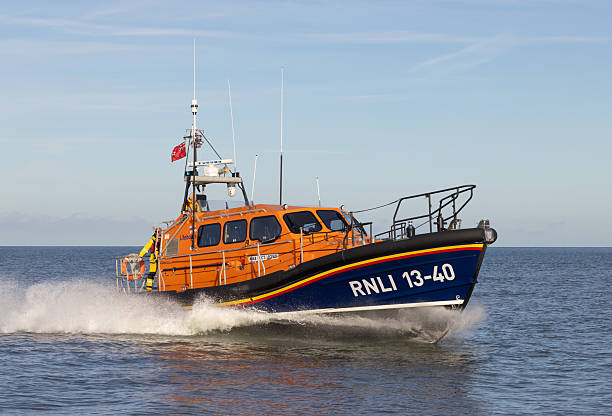
For more than 200 years, the Royal National Lifeboat Institution has sent volunteers into some of the most dangerous waters surrounding Britain and Ireland to save complete strangers.
Fishermen, children, sailors, swimmers, tourists, people attempting suicide, people who have made foolish decisions, people who have simply been desperately unlucky. The question asked when the pager sounds has never been whether that person deserves to be rescued.
Increasingly, however, another category has been added to that list: men, women and children attempting to cross the English Channel in small boats. For some, that appears to have changed everything.
In September 2026, Portsmouth RNLI was temporarily taken off service following protests and abuse directed at its volunteers. Crew members had been confronted following the rescue of people crossing the Channel, while individuals connected with the RNLI were targeted online. Volunteers elsewhere were advised to consider not wearing RNLI-branded clothing where doing so might put them at risk. Reports described crew members being branded “traitors” for bringing people safely ashore.
Pause on that for a moment: Volunteer lifeboat crews – people who leave their homes, families and jobs when a pager sounds, sometimes heading into conditions in which they themselves may die – have been abused because some of the people they rescued were migrants.
There are perfectly legitimate political arguments to be had about immigration. There are legitimate questions about border security, people-smuggling, asylum policy, safe routes and how the United Kingdom responds to these concerns.
But there is a point at which immigration policy ends and something much simpler begins – A human being is drowning.
Saving Lives, Not Policing Borders
The key thing to be reminded of is that the RNLI is not Border Force.
It is an independent charity, funded overwhelmingly through donations and legacies, whose purpose is simply to save lives at sea. HM Coastguard coordinates maritime search and rescue around the United Kingdom and can task RNLI lifeboats when someone is in danger. The UK Government’s own Search and Rescue framework confirms that HM Coastguard is responsible for coordinating the response to people in distress at sea.
When an RNLI crew reaches an overcrowded inflatable boat taking on water, its volunteers are not conducting asylum interviews. They are not deciding whether someone is a refugee, an economic migrant, the victim of trafficking, a smuggler or someone with no lawful basis whatsoever for entering the United Kingdom. The RNLI are not there to check documents, status, or reasoning.
Nor should they be there to do so. The RNLI describes its position in perhaps the simplest possible terms:
Anyone can drown. No one should.
That is not a political slogan. It is the organising principle of maritime rescue. The RNLI explains that, once casualties have been brought to safety, responsibility is passed to the relevant authorities, which may include the police, ambulance service or Border Force. Its role in Channel rescues is explained here.
Rescuing somebody does not give them asylum.
It does not grant them indefinite leave to remain.
It does not prevent their arrest, investigation, removal or prosecution where the law permits any of those things.
It simply prevents them from drowning before the law gets the opportunity to decide what happens next.
It shouldn’t have to be said, but clearly that isn’t the case: A lifeboat is not a floating immigration tribunal.
The Law of the Sea is Remarkably Clear
There is also a danger in treating the RNLI’s approach as merely an act of charitable kindness. Rescue at sea is rooted in a much older and broader body of international law.
Article 98 of the United Nations Convention on the Law of the Sea requires states to ensure that masters of ships render assistance, it stating that:
1. Every State shall require the master of a ship flying its flag, in so far as he can do so without serious danger to the ship, the crew or the passengers:
(a) to render assistance to any person found at sea in danger of being lost;
(b) to proceed with all possible speed to the rescue of persons in distress, if informed of their need of assistance, in so far as such action may reasonably be expected of him;
[…]
2. Every coastal State shall promote the establishment, operation and maintenance of an adequate and effective search and rescue service regarding safety on and over the sea and, where circumstances so require, by way of mutual regional arrangements cooperate with neighbouring States for this purpose.
The word any matters here. This is not “any citizen” nor any “lawful traveller” nor any “person with the correct visa”. It is simply any person in danger.
The International Convention on Maritime Search and Rescue was adopted to ensure that people in distress at sea could be rescued through organised and coordinated systems. The International Maritime Organization describes the principle as assistance being provided:
…regardless of nationality or status.
SOLAS, the International Convention for the Safety of Life at Sea, similarly requires ships able to assist people in distress to do so irrespective of their nationality, status or the circumstances in which they are found.
As it should, because the sea does not discriminate against immigration status. Hypothermia does not slow down while somebody’s asylum claim is examined. An overcrowded dinghy does not become more seaworthy because the people onboard lack permission to enter Britain. A child entering the water does not float differently according to which passport they carry.
Maritime law developed this way because the alternative is grotesque. If rescuers were required first to establish whether somebody was legally entitled to be travelling, rescue itself would become conditional on status.
There is also a broader danger in allowing that principle to take hold. Today, the argument may be that rescue should be withheld from migrants who have crossed a border irregularly. But once we accept that some categories of people may be left to die because of who they are, what they have done, or how politically unpopular they have become, the line is no longer fixed. A different government, in a different climate, may draw it somewhere else. The safeguard lies not in trusting that those in power will always choose the “right” people to exclude, but in refusing to create the power to exclude anyone from rescue in the first place. The sea is a particularly unforgiving place in which to discover that yesterday’s exception has become tomorrow’s rule.
The Right to Life
Article 2 of the European Convention on Human Rights begins with one of the most fundamental statements found anywhere in human-rights law:
Everyone’s right to life shall be protected by law. No one shall be deprived of his life intentionally save in the execution of a sentence of a court following his conviction of a crime for which this penalty is provided by law.
The Council of Europe’s explanation of Article 2 describes the right to life as one of the Convention’s most important rights, because without life none of the remaining rights can meaningfully be enjoyed.
For public authorities, Article 2 can involve more than simply an obligation not deliberately to kill. European human-rights law recognises positive obligations, in appropriate circumstances, to take reasonable steps to safeguard people where authorities know, or ought to know, of a real and immediate risk to life.
When Rescue Fails
This debate cannot be separated from what has already happened in the Channel. On the night of 23–24 November 2021, a small boat carrying at least 33 people capsized while attempting the crossing. Only two people survived. The independent Cranston Inquiry reported in February 2026 after examining what happened that night.
The conclusion was devastating:
…the loss of life was avoidable.
The Inquiry found serious systemic problems in the search and rescue response. HM Coastguard’s Dover operation was under immense pressure; Border Force resources were insufficient; communication and record-keeping failed; and a belief had developed among some Coastguard personnel that people aboard small boats exaggerated the danger they were in.
Crucially, the Inquiry found that the RNLI itself had been stretched by the increased demands placed upon it, despite taking proactive steps to increase its ability to respond. It also concluded that an RNLI lifeboat would have been better suited to rescuing people from a sinking small boat or directly from the water during that disaster.
The Inquiry’s expert evidence suggested that many of those onboard did not die immediately. Some were probably alive for hours in the freezing water.
They waited for rescue, and it never reached them in time.
RNLI as a “Taxi Service”
A recurring criticism is that the RNLI has somehow become a “taxi service” for people crossing the Channel. The facts do not support that characterisation.
In 2025, the RNLI recorded 109 launches to small boats in the Channel, representing just 1.2% of its launches. Of the 41,472 people recorded as crossing in small boats that year, the RNLI says 94.3% were assisted by other agencies, including Border Force. The RNLI publishes those figures alongside its explanation of Channel operations.
More fundamentally, describing rescue as a “taxi service” confuses two completely different things. A taxi takes somebody where they want to go. A rescue vessel takes somebody away from a situation in which they may die.
RNLI crews do not patrol the French coastline offering passage to Britain. They respond when tasked by HM Coastguard to people assessed as requiring assistance, bring casualties to safety, and hand them over to the relevant authorities. After that, immigration law takes over.
People can support tougher border controls and still support rescue at sea. They can believe that somebody has no right to remain in Britain and simultaneously believe they should not drown in the Channel before that question is determined. The positions are not contradictory.
Rescuers as Targets
That is what makes the recent hostility towards RNLI volunteers so troubling.
The Portsmouth station serves the eastern Solent and responds to emergencies involving everyone from recreational sailors to people caught in mud, swimmers, kite surfers and vessels in distress. Its crews are volunteers.
Yet following the September protests, one of Britain’s lifesaving stations was temporarily unable to operate normally because of concerns for those volunteers’ safety. Rescue coverage remained available through contingency arrangements and neighbouring stations, but that should not obscure how extraordinary the situation had become.
Nevertheless, the RNLI is clear that it remains focused upon saving lives “without judgement or preference”, as it has for more than two centuries.
There is an uncomfortable irony here. People who volunteer to enter the sea to save strangers are being accused of betraying their country because they refuse to decide which strangers are worth saving.
Imagine the alternative. A lifeboat approaches an overturned vessel. Before recovering the people clinging to its side, the crew asks for passports. Perhaps nationality first. Then immigration status. Perhaps criminal records. Perhaps whether they paid a smuggler. Perhaps their political beliefs.
By the time those questions are answered, there may be nobody left to rescue. Human rights exist precisely to prevent this kind of calculation. The right to life is not a reward for lawful behaviour, good character or citizenship. If rights disappear the moment somebody becomes unpopular, politically inconvenient or accused of wrongdoing, they were never rights in the first place.
At sea, the situation is considerably simple.
You save the person first.
Their passport can wait until shore.

Avaia Williams – Founder
This blog was published on Friday 18th September 2026


Excellent post, though l doubt the ‘Men in Black’ would get past the first paragraph.
LikeLike