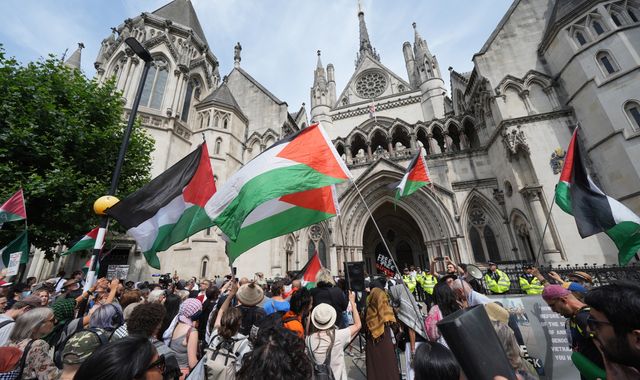
Palestine Action formed in 2020 as a direct action network targeting UK companies and institutions complicit in the Israeli arms trade. The group is most known for its campaign to shut down factories owned by Elbit Systems, Israel’s largest private weapons manufacturer, whose technologies have been used in the Israeli military’s bombardments of Gaza.
Palestine Action’s methods are unapologetically disruptive and include occupying arms factories, scaling buildings, disabling machinery, spraying symbolic red paint to represent bloodshed, and blockading supply chains. Activists see their actions as morally necessary civil disobedience in the face of ongoing war crimes and ethnic cleansing in Gaza.
The group does not advocate violence against persons. Rather, it targets property and infrastructure involved in the manufacture and delivery of military equipment, with the stated aim of halting the UK’s complicity in the genocide being committed against the Palestinian people in Gaza and the Occupied West Bank.
Why are PalAction Being Proscribed?
On 20 June 2025, Palestine Action activists accessed RAF Brize Norton, a military airbase in Oxfordshire. There, they reportedly caused significant disruption, including spraying red paint into the engines of two RAF Voyager aircraft, allegedly worth £250m. The damage was estimated reported at £7 million (though one of the aircraft was reported to have been in the air only a few days later). The group stated these aircraft were being used to supply arms and logistical support to the Israeli Defence Forces (IDF), and that their action was part of an effort to disarm genocide.
The Home Secretary, Yvette Cooper, used this incident to fast-track an application to proscribe Palestine Action under the Terrorism Act 2000, arguing that the group endangers national security and is committed to criminal damage, serious disruption and dangerous trespass. In introducing the Proscription, the Home Secretary reported that:
“Palestine Action’s online presence has enabled the organisation to galvanise support, recruit and train members across the UK to take part in criminal activity and raise considerable funds through online donations. The group has a footprint in all 45 policing regions in the UK and has pledged to escalate its campaign.”
Legal Implications
On 4 July 2025, Palestine Action’s legal team brought an urgent challenge to the High Court, seeking interim relief to pause the proscription. The challenge argued that banning a protest group under terrorism law was unlawful, disproportionate, and a grave infringement on democratic freedoms.
However, the High Court dismissed the application for interim relief, paving the way for the ban to take legal effect on 5 July 2025. The group is understood to be preparing to appeal the ruling and will pursue a Judicial Review of the Home Secretary’s decision later this month. The groups barrister, Raza Husain KC stated that:
“This is the first time in our history that a direct action civil disobedience group, which does not advocate for violence, has been sought to be proscribed as terrorists,”
From Saturday 05 September 2025, the group will officially be a Proscribed Group. Under the Terrorism Act 2000, it will thereafter be a criminal offence to:
- Belong to Palestine Action
- Invite support for Palestine Action
- Express support for Palestine Action, including in speech or writing
- Arrange meetings to support Palestine Action or its aims
- Display articles, such as logos, banners, or symbols indicating support for Palestine Action
The penalties for a breach includes up to 14 years in prison, this is the case even for entirely non-violent or disruptive forms of expression, including on social media – in fact, blog posts such as thus, under some stringent interpretation could be argued to be a breach (though it would be strongly resisted this is the case, this is part of the danger in these laws, the lines become blurred).
The Terrorism Act defines terrorism broadly to include “serious damage to property” where the use of force is designed to influence government or intimidate the public. It allows for proscription where the Secretary of State believes an organisation is “concerned in terrorism”—a threshold many argue is dangerously low when applied to political protest.
Protest not Terrorism
The proscription of Palestine Action is deeply alarming. It marks the first time a UK protest group – with no record of violence against individuals – has been banned under terrorism legislation. This is not just an escalation; it is a radical redrawing of the boundary between protest and terrorism.
Property damage, even significant, has long been part of civil disobedience traditions, from the Suffragettes to anti-apartheid activists. Palestine Action has always made clear that their target is the infrastructure of arms production – not people. To put it this way, if such direct action had been banned since time immemorial, then women would not have the right to vote, children would still be working in dangerous conditions, and apartheid would be rife in South Africa.
To conflate these acts with terrorism is to criminalise dissent. It silences voices standing in solidarity with the people of Gaza, where over 50,000 Palestinians have been killed since October 2023, the majority of them women and children. Entire neighbourhoods have been levelled, hospitals bombed, and food supplies cut. The International Court of Justice has stated that Israel’s actions may plausibly amount to genocide.
While many see the issue in Palestine as starting in October 2023, the violence of occupation and apartheid stretches far beyond this current moment. What we are witnessing is not a sudden crisis, but an escalation of a systemic and long-standing campaign of dispossession.
Since 1948, when more than 750,000 Palestinians were forcibly displaced during the Nakba, Israel has pursued a policy of expansionism and demographic engineering. This has included the illegal annexation of East Jerusalem, the construction of a separation wall condemned by the International Court of Justice, and the rapid growth of Israeli settlements in the occupied West Bank – settlements that are unequivocally illegal under international law.
More than 700,000 settlers now live in these enclaves, protected by a dual legal system that discriminates between Jewish settlers and the Palestinians whose land they occupy. Palestinian homes are routinely demolished. Communities are displaced under the guise of “security” or “zoning violations.” Gaza, meanwhile, has been subjected to a crippling blockade since 2007, turning it into what human rights organisations have described as the world’s largest open-air prison.
This is not a “conflict” between equal sides. It is a decades-long regime of apartheid and ethnic cleansing – documented in detail by groups such as Amnesty International, Human Rights Watch, B’Tselem, and the UN Special Rapporteur. To protest this system, and to directly disrupt the arms companies enabling it, is to stand on the side of international law and human dignity.
In this context, activists who take non-lethal direct action to halt the machinery of destruction should not be treated as terrorists. They should be recognised as part of the global movement against war crimes and apartheid.
Solidarity Opposed to Silence
This ban is not just about Palestine Action. It is about the future of protest in the UK. If the state can designate a protest group as terrorist for damaging property in pursuit of a just cause, who is safe? Whenever protest rights are discussed, it is so important to remember that the rights which give people the ability to dissent and oppose one group’s voice, is the right which gives that group the voice.
The Nightingale Rights Initiative stands firmly against this proscription and in solidarity with all those acting to stop genocide, apartheid, and arms profiteering. We reject the framing of resistance as terrorism and call for the repeal of this designation.
The right to protest must not become collateral damage in the UK’s complicity with Israel’s war on Gaza.

Avaia Williams – Founder
This blog was published on Monday 4th July 2025
 Nightingale Rights Initiative
As if they could arrest, sentence and jail everyone waving a flag. We all know they would just drag a few from the crowd and throw the book at them to deter others. Starmer has made a rod for his and the Labour Party’s back now because the anger at his government is rising dramatically. Rather than deter activists it will only add fuel to the fire. ✊
LikeLike