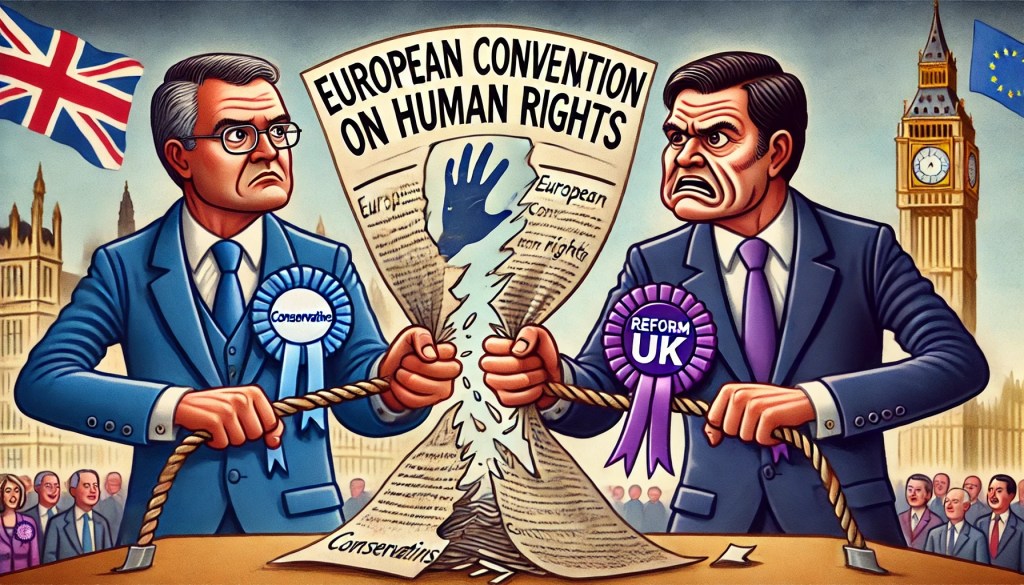
The European Convention on Human Rights (ECHR) has played a pivotal role in shaping the human rights landscape of the United Kingdom. However, both the Conservative Party and Reform UK have proposed to leave the ECHR, sparking intense debate about the future of human rights protections in the country. This article delves into the implications of such a move, highlights key cases and innovations brought by the ECHR to the UK, and argues for the importance of remaining part of this supranational entity.
Conservative and Reform UK Plans
The Conservative Party and Reform UK have expressed strong desires to regain full sovereignty over national laws, which includes withdrawing from the ECHR. Their argument is predicated on the belief that the ECHR infringes upon British sovereignty and that domestic courts should have the final say in human rights matters.
Conservative Party
The Conservative Party’s manifesto argues that the ECHR often hampers the UK’s ability to effectively manage issues such as immigration and counter-terrorism. They propose replacing the Human Rights Act 1998, which incorporates the ECHR into UK law, with a new Bill of Rights. This new legislation would purportedly restore parliamentary sovereignty and ensure that the UK’s Supreme Court is the ultimate arbiter of human rights issues. On the European Court, the Conservative Manifesto notes:
“If we are forced to choose between our security and the jurisdiction of a foreign court, including the ECtHR, we will always choose our security.”
Reform UK
Reform UK takes an even more hardline stance, suggesting that the ECHR undermines British law and governance. They advocate for a complete withdrawal from the ECHR, arguing that it would allow the UK to better control its borders, manage immigration, and enhance national security. Reform UK’s manifesto frames the ECHR as an outdated institution that no longer serves the best interests of the UK, noting it would leave the ECHR within the first 100 days. Reform UK goes further, concerningly stating that they would:
“Protect our servicemen and women on active duty inside and outside the UK from civil law and human rights lawyers.”
Key Cases and Innovations Brought by the ECHR
Since its inception, the ECHR has significantly influenced the development of human rights in the UK. Several landmark cases illustrate the vital role the ECHR has played in safeguarding individual freedoms and promoting justice.
Right to Life and the McCann Case
The McCann v. United Kingdom (1995) case, concerning the killing of IRA suspects in Gibraltar by British forces, underscored the ECHR’s emphasis on the right to life. The European Court of Human Rights (ECtHR) ruled that the use of lethal force by the British government was a violation of Article 2 of the ECHR. This case highlighted the necessity for stringent controls and accountability measures regarding the use of force by the state.
Freedom from Torture: The Chahal Case
Chahal v. United Kingdom (1996) was a seminal case where the ECtHR ruled against the deportation of Mr. Chahal, a Sikh separatist, to India due to the risk of torture. This decision reinforced the absolute prohibition of torture and inhumane treatment under Article 3 of the ECHR, shaping UK policies on deportation and asylum. The Court stated that:
“Article 3 enshrines one of the most fundamental values of democratic society […] The Court is well aware of the immense difficulties faced by States in modern times in protecting their communities from terrorist violence. However, even in these circumstances, the Convention prohibits in absolute terms torture or inhuman or degrading treatment or punishment, irrespective of the victim’s conduct.”
Right to a Fair Trial: The Golder Case
In Golder v. United Kingdom (1975), the ECtHR ruled that prisoners have the right to access courts, establishing an important precedent for the right to a fair trial (Article 6). This case emphasised that prisoners retain certain fundamental rights, influencing UK prison policies and judicial access.
Privacy and Family Life: The Marper Case
The case of S and Marper v. United Kingdom (2008) dealt with the indefinite retention of DNA profiles of individuals who had not been convicted of any crime. The ECtHR found this practice violated Article 8 (right to respect for private and family life), prompting significant reforms in how biometric data is managed in the UK. In passing judgment, the Court held:
“…the blanket and indiscriminate nature of the powers of retention of the fingerprints, cellular samples and DNA profiles of persons suspected but not convicted of offences, as applied in the case of the present applicants, fails to strike a fair balance between the competing public and private interests and that the respondent State has overstepped any acceptable margin of appreciation in this regard.”
Importance of Remaining Part of the ECHR
Remaining a part of the ECHR is crucial. The ECHR provides robust protections for fundamental rights that may not always be adequately safeguarded by domestic laws or the common law. Its comprehensive framework ensures that individuals can seek redress for human rights violations even when national mechanisms fail.
The European Court of Human Rights serves as an essential oversight body, holding states accountable for human rights violations. This external scrutiny helps maintain high standards of human rights protection and encourages governments to adhere to international norms, the majority of human rights claims are against the state, as such, having the state itself as the last backstop in questions of human rights represents an alarming system.
The ECHR has driven significant legal and social progress in the UK. Cases adjudicated by the ECtHR have led to reforms that might not have occurred through domestic channels alone. The convention acts as a catalyst for continuous improvement in human rights protections and requires states to constantly do better, rather than sit on the floor of what is acceptable.
The Conservative and Reform UK proposals to leave the ECHR raise serious concerns about the future of human rights in the UK. The ECHR has been instrumental in safeguarding fundamental freedoms and promoting justice. Its role in ensuring accountability, providing oversight, and driving legal and social progress cannot be overstated. As such, remaining a part of this supranational entity is crucial for upholding the high standards of human rights protection that the UK has long championed. The move to withdraw would not only undermine these protections but also signal a troubling shift away from the values that have been central to the UK’s identity on the international stage.
There is a notable paradox in the positions of the Conservative and Reform UK parties, which emphasize national sovereignty. The ECHR, after all, was largely drafted and spearheaded by the UK in the aftermath of World War II. Furthermore, the rights protected by the ECHR, such as free speech, are precisely those that allow political discourse and the promotion of ideas, including those espoused by parties like the Conservatives and Reform UK. Ironically, the same framework they seek to dismantle is what enables their own rhetoric and policy proposals to thrive. This contradiction underscores the broader importance of maintaining robust human rights protections for all, and shows the dangers of making a complex area such as human rights, a black and white, populist election talking point.

Avaia Williams – Founder
This blog was published on Monday 24th June 2024
 Nightingale Rights Initiative
This article presents a thought-provoking analysis of the UK’s ECHR election dilemma, balancing rights conservation and reform. Great read!
LikeLike