
The United Nations Human Rights Council (UNHRC), that big, international group that purports to champion and protect all things related to human rights, have just announced their new lineup, and it isn’t what you would expect – unless, of course, like us, you have been beaten down into a cynic when it comes to human rights. Among those who are stepping onto the global stage for the first time from January 2024 include expected candidates such as France and the Netherlands, but some surprise countries are Cote d’Ivoire and Kuwait. It may come as no surprise that Russia, the country which invaded Ukraine last year, failed to get re-elected to the council.
To secure membership on the Council, states need to “promote and protect all human rights and fundamental freedoms”, you may therefore find some members of this list not only surprising, but against the very ethos of this principle. Read on as we explore the top 10 nations now sitting on the 47 strong Human Rights Council with the worst human rights records. Be warned, some truly are shocking!
10 – United Arab Emirates

Kicking off this list is the UAE, a country which many may have expected to be much closer to the coveted number 1 spot, a country made up of seven emirates including Dubai and Abu Dhabi, has a very public history with human rights violations, with all major NGO’s actively criticising the country.
Whilst the country has made ‘some’ progress in recent years, such as allowing women to drive, no clear picture can be drawn for many outside of the country due to the UAEs ‘soft power’ strategy to improve the countries profile on a global scale (in short, a giant and state funded propaganda drive).
The landscape of free expression and belief within the country remain barren and dangerous, with numerous political prisoners serving arbitrary sentences after unfair hearings, including Ahmed Mansoor, a human rights activist who has been sentenced to 10 years imprisonment for “threatening state security” over his blog calling on the state to reform.
The UAE are guilty of refusing medical treatment to detainees suffering from HIV and overall have an abysmal detention record, with international monitoring groups, including the UN themselves, being prevented from conducting visits to the state’s prisons and facilities (which is unsurprising considering they are not a signatory to OPCAT).
The UAE consistently rank low in global indexes, most recently being placed in 127th place in the Human Freedom Index Ranking. It is for these reasons they take our number 10 spot.
9 – Qatar

Coming to more prominent attention last year due to the hosting of the World Cup, Qatar is another middle eastern state which has a poor record of upholding human rights. Whilst the country has attempted to paint over this abuse (most notably due to the aforementioned World Cup) it has done little to actually change these practices.
Qatari laws are extremely prejudicial against LGBTQ+ individuals, with their laws criminalising anybody who “tempts” another “by any means” into a homosexual act, an arbitrary definition at best which could be used to prosecute countless individuals.
Whilst the Qatari Constitution prohibits torture and inhuman treatment, in practice this is ignored, with flogging regularly being ordered. The state does not allow independent monitoring of its prisons and so self-reporting that all prisons meet international standards is almost certainly a falsehood. With individuals entering such prisons to serve life sentences simply for organising public meetings and questioning the state online.
Qatar, despite best attempts to hide the fact, remains one of the worst abusers of human rights worldwide, as such, it snags the number 9 spot on this list.
8 – Bangladesh
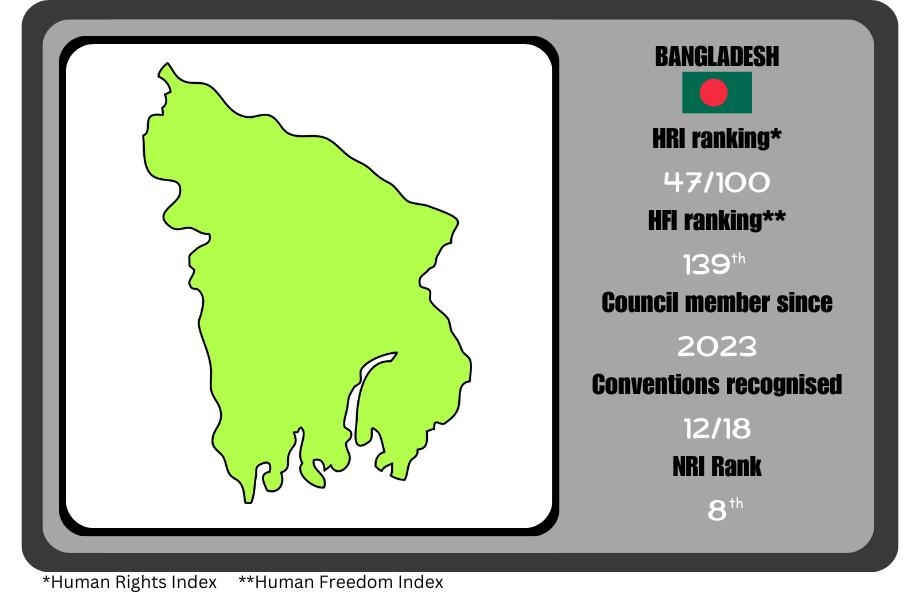
The first South Asian country in this list, Bangladesh is one not often raised in discussions on international human rights, at least not in the West, however, the country has a rich tapestry of abuse, torture, and discrimination. Despite being a member of the UNHRC, the first ever visit by the UN Commissioner for Human Rights took place only a year ago.
The police regularly deploy batons, tear gas, rubber bullets and live ammunition against protestors, including several being shot dead. More deaths occur from torture within the prison estate, including reports of torture being carried out against prisoners whose families do not pay bribes.
Bangladesh have not ratified numerous international conventions, including the Convention for the Protection of All Persons from Enforced Disappearance nor OPCAT, resultingly the country regularly executes prisoners without trial and ‘disappears’ numerous others, with their fates entering a state of indefinite limbo.
Bangladesh is a state finally being discussed more in the West, and for good reason, with rights against workers, women, refugees, politicians, and many others being non-existent, the country rightfully takes number 8.
7 – Viet Nam

As one of the few remaining communist states, it is unsurprising that human rights take a back burner in Vietnam, however, as a popular tourist destination, abuses are routinely covered up by the state and the true picture is likely never going to be understood.
Confessions are regularly extracted by torture and detainees then kept in prison without contact to the outside world, including families or legal representation. Many are sentenced to unbelievably long sentences for minor ‘offences’ such as calling for action on climate change or blogging about the government, with prominent activists regularly being sentenced to up to a decade in harsh prison conditions.
Human rights NGOs and activists are regularly surveilled, arrested and harassed by the state with torture and ill-treatment being reported at a exceedingly concerning rate. In an almost laughable act, after declaring itself for candidacy for the UNHRC, Viet Nam arrested and/or sentenced at least 48 journalists and NGO leaders.
Those who “spread propaganda” are often beaten and tortured in prison, many whilst awaiting trial, others die in detention due to healthcare being restricted or removed entirely.
Viet Nam is one of the few states whose Human Rights Index score has drastically dropped in the past few decades, showing an alarming decline in the treatment of those within the state, it is for this reason that number 7 is awarded.
6 – Algeria

A familiar face to any who even take a cursory look into international human rights, Algeria has a 60 year history, most of those years spent denying the most basic of rights to its citizens. Women are prevented from moving freely in public without a male guardian or their permission and domestic abuse regularly leads to the deaths of women and girls due to a state ignorance of the practice, with wives being considered property.
Protest is a dangerous act within the country, even peaceful assembly results in widescale arrests, simple actions such as carrying a flag can lead to years spent behind bars. Many opposition parties, such as the Socialist Workers’ Party, have been suspended by the State, resulting in little political resistance.
Torture is a routine occurrence in Algeria, with domestic courts ruling that deporting anybody to Algeria has a severe risk of breaching the Article 3 rights of prospective deportees and that, even with diplomatic assurances, the likelihood is that torture may still occur. The preferred methods of torture employed by Algeria include electric shock, beatings, and forced swallowing of water, urine, or chemicals (known as the Chiffon Method).
It is unlawful to practice any religion other than Sunni Islam and places of worship are routinely closed and licensed to build them refused. Anybody who goes against such law can face years imprison for “offending Islam”, such as Hamid Soudad who was sentenced to five years imprisonment for practicing Christianity.
For its long standing history of abuse and a clear path forward of this continuing, Algeria has taken the first halfway place at number 6.
5 – Morocco

Another popular tourist destination, and a country few will first think of when human rights abuse is raised, Morocco is entering the list strong with even the most basic of rights such as the ability to move workplace or home being severely limited.
Human rights defenders and NGO activists are often spied upon, with Amnesty International reporting on a case early last year in which Israeli Spyware ‘Pegasus’ was found on the phones of Aminatou Haidar.
Calls for improvement to work and education rights are regularly met with violent and brutal responses from the police who are empowered to torture and rape activists, both inside and outside the prison system. Considering rape is a crime against morality rather than the individual in Morocco, it is no surprise such actions occur on a state scale.
LGBTQ+ rights are non-existent in the country, with information and books about sexuality being censored by the state and the practice of homosexuality being met with up to three years imprisonment. The Asher & Lyric Travel Safety Index has marked Morocco as the 25th most unsafe country to visit for LGBT individuals.
Migrants and asylum seekers have been killed for attempting to enter Morocco to claim asylum with the state conducting no effective investigations, for that reason, and those above, Morocco snags the second middle spot of 5.
4 – Burundi
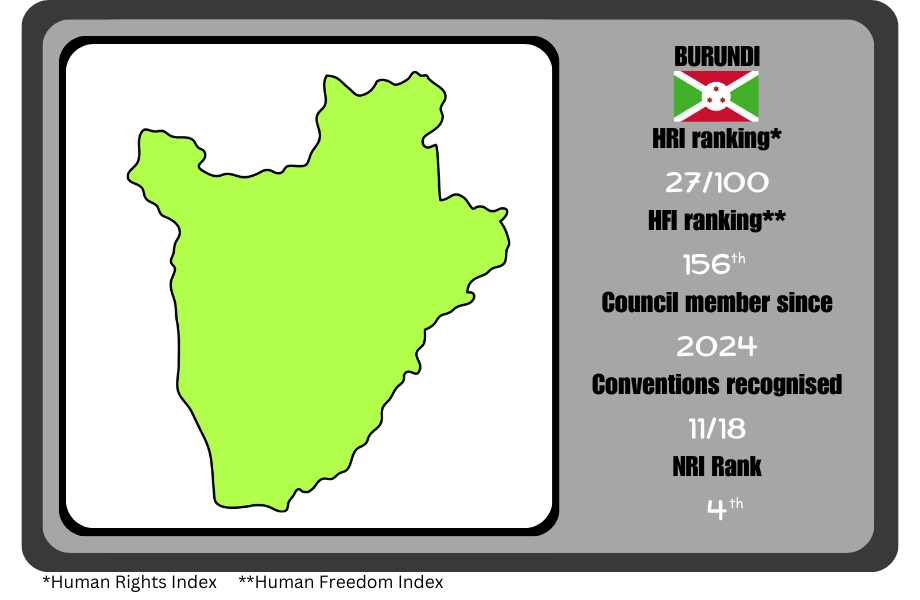
Worryingly, Burundi is the only state on this list new to the UNHRC, having been formerly elected to the role on 10 October 2023. However, Burundi, like all on this list, has clearly earned its place despite hopes that the recent change in leadership would pave the way for a safer country.
20% of Burundi’s population need humanitarian assistance, notably being exacerbated by the authorities refusal to cooperate with such relief and rights mechanisms. The Burundi Genocide and Civil War continue to have lasting effects, with ‘victors justice’ significantly undermining fundamental truths of the conflict and the ruling party declaring the Hutu as the sole victims of the massacres.
The right to life is one barely guaranteed in the state with hundreds of bodies being found dumped in rivers in recent years, many having clearly been murdered. The number of enforced disappearances still remains high, many of those who go missing are members of the main opposition party, the CNL.
Burundi, despite being a State Party to numerous international conventions, is regularly listed as one of the worst perpetrators of human rights abuse in the world, being ranked at the 10th worst country on the Human Freedom Index and 23rd worst on the Human Rights Index.
Burundi, for its appalling record at providing even the most fundamental rights such as that to life, has unsurprisingly entered our list at number 4.
3 – China

An unsurprising entrant to our list, China, as the only other communist country on this list, remains committed to statewide abuses of human rights and the denial not only of such rights, but of entire peoples within its borders.
Human rights defenders, including lawyers and journalists, are regularly imprisoned in vile conditions, being subjected to torture and inhuman treatment. Many such prisoners are tried in secretive security courts without any oversight.
China continues to be the leading country at executing people, with death via firing squad remaining enforceable for 46 offences, 22 of then non-violent in nature, with estimates from NGO WCADP stating that roughly 8,000 executions are carried out each year.
The Chinese Communist Party continues their tirade against the Uyghur Muslims, with Genocide Watch noting that the genocide is now in the execution stage meaning thousands are actively and systematically being killed. The unofficial Uyghur Tribunal reported in its judgment that mass sterilisation, enforced abortion, forcible transfer of children are occurring in record numbers and the level of internment is the highest since the concentration camps of Nazi Germany.
China state control over the internet and media make it difficult for the true scale of atrocities to be understood. The level of control and censorship was somewhat understood when foreign journalists were monitored, restricted and censored when covering the Winter Olympic Games.
With the ability to even spend money being tightly controlled by the state, China has rightfully earned its show place as our number 3 offender.
2 – Somalia
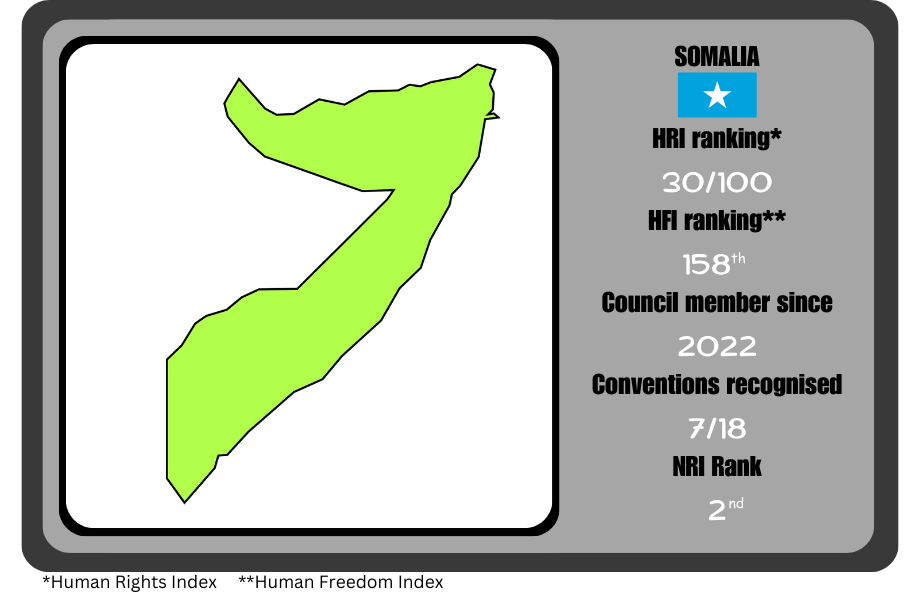
With its civil war entering its third decade, there is no shock with Somalia being a significant human rights abuser, however, its position on the United Nations Human Rights Council remains abhorrent and leaves many NGOs and activists speechless.
MILLIONS of Somali citizens have been displaced internally or fled the country as refugees and asylum seekers (for the ‘close our border’ folk out there, 80% are living in neighbouring countries within Africa).
An uncountable number of citizens are killed yearly by state security forces without any judicial inquiries taking place and no accountability for those actors involved. Those not killed by the state are often subject to suicide bombings and coordinated attacks from Al-Shabab, skyrocketing Somalia to the number three spot on the Global Terrorism Index.
Somalis struggle to have their right to food recognised, with geo-political conflicts adding to the strain, over half of the population are dependent on humanitarian assistance to survive. Over 1 million children are malnourished and last year almost a thousand children died in nutrition centres.
Children and women bear a large proportion of abuse, with the education establishments that do exist being attacked and women and girls routinely being sexually assaulted and raped, even if most victims were not murdered after, they would struggle to obtain justice as Somalia treats such offences as offences “against modesty and sexual honor”.
If being killed by the army, hunger, terrorists and murder wasn’t enough, parts of Somalia still enforce the death penalty for being gay, it is therefore our honour to award Somalia the runner-up prize of number 2.
1 – Sudan
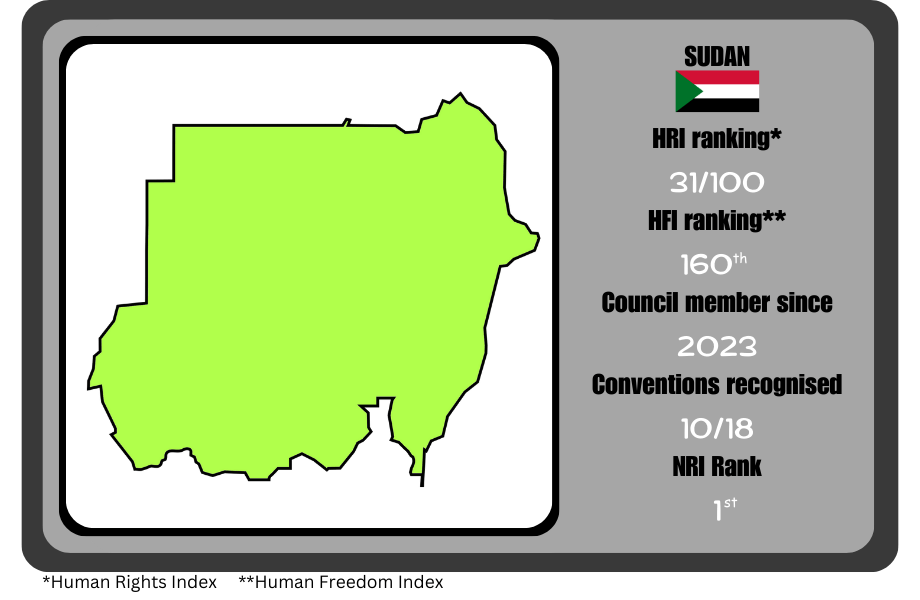
No pomp and circumstance is needed for the introduction of our winner, Sudan, by far, has the worst human rights record of any member of the UNHRC and one of the worst records out of all countries on the globe.
Rape and sexual violence is a tool available to all members of the Sudanese Security Forces (“RSF”) and, despite being a member of the UNHRC, was told by the UNHRC, that the situation where women and girls are being kidnapped, detained, and entered into sex slavery is alarming.
War crimes have been reported to the International Criminal Court and the Prosecutor, Karim Khan KC, has launched an investigation. Over 4,000 civilians have been killed in the conflict currently playing out in Sudan with UN specialists witnessing occasions of people being denied safe passage to flee.
The Sudanese government have used the heightened tensions to restrict peaceful protest, including disappearing many who choose to speak out. Those who are detained are subject to torture, including being kicked by horses, beating with rods, denied food and sleep, and being put into illegal stress positions.
Sudan persecutes those who seek to practice a divergent religion, being marked at 10th place on the Open Doors’ Watch List, with church leaders being arrested and tortured and those who choose to protest for the right to practice their belief are regularly killed by state and military officials.
It is no surprise that Sudan has a Human Rights Index score of 31 of 100, is 9th place on the LGBT Index, and is regarded as the 6th worst country on the globe for human freedoms.
With attacks on the press, judicial bias, FGM, corruption and overall ignorance of what it means to promote human rights, Sudan has easily secured the top spot in our list.

Avaia Williams – Founder
This blog was published on 11 October 2023
 Nightingale Rights Initiative
Another excellent blog. I wonder how much blood money changed hands to enable them to become members.
LikeLiked by 1 person