Individual liberty is something which is unduly restricted, encroached upon, and outright beaten down every day. Billions go without the protections of human rights, and even those with such protections will often find themselves under the hammer of state abuse. It is impossible to recite every instance and to raise awareness of the true scale of this issue.
However, I have chosen to highlight a few stories of human rights abuses currently occurring across the globe:
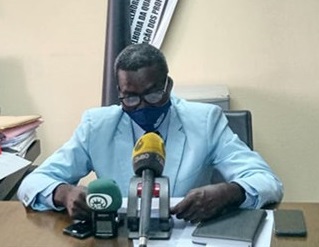
Eduardo Peres Alberto
Starting in Africa, Eduardo is the general secretary of the National Union of Higher Education Teachers in Angola. Earlier this year, the union began a strike to demand better working conditions and to try to enforce promises which were earlier made by the government of Angola due to the governments reneging on this.
Unfortunately, due to this strike action, and due to Eduardo being the figurehead of the union, both he and his family have been receiving countless death threats and his daughter has been victim of a chemical attack openly in the public streets.
The right to strike and protests is something which is very repressed in Angola, taking such action regularly leads to arrest without cause, threats, intimidation, and even the torture of those who engage in these actions.
Amnesty International is seeking public action against these abuses and is currently running a call to action in respect of the abuse of Eduardo Peres Alberto and his family – You can see the action and sign the expression of concern HERE.
Guillermo Zárraga
Moving to South America, Guillermo Zárraga is an engineer and unionist from Venezuela. He has been detained by the state since 2020 on false charges of espionage and claims of supplying information to a CIA officer, without any evidence being laid against him. Guillermo now lays in prison, suffering severely due to inhumane detention and receiving inadequate healthcare, food, nutrition and basic standards of living within his prison.
Guillermo is unsupported within prison, his family is unable to provide any financial aid and there is little support from outside agencies or third parties. He is without even the most basic level of drinking water and, unfortunately, in recent months, Guillermo’s health has deteriorated substantially – Unsurprisingly, the number of Venezuelans fleeing the country is nearing 10 million this year alone.
The Independent International Fact-Finding Mission on the Bolivarian Republic of Venezuela has found hundreds of cases of executions, disappearances, detention, and torture without any grounds, cause, or trial… Guillermo has likely suffered similar treatment. You can sign the call to action HERE.
1,461 Belarusian Citizens
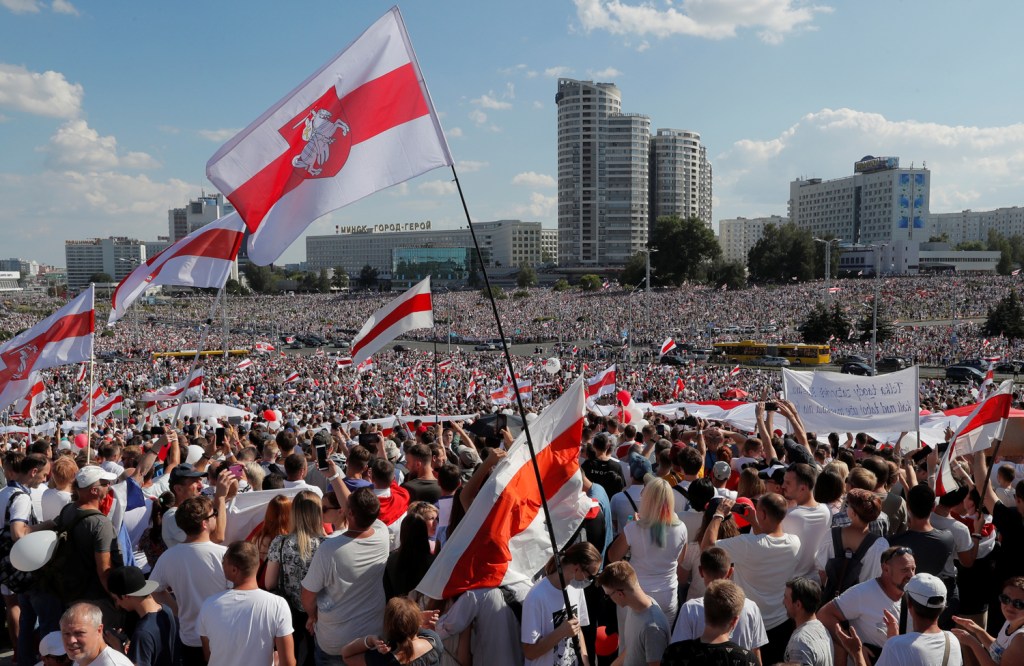
Finally heading to Eastern Europe and not with a person, but thousands of people currently suffering at the hands of Belarus. Thousands of citizens have taken to the streets, internet, and private conversation to call out the government and provide critical opposition. This has resulted in arbitrary detention and restriction of fundamental freedoms within the country.
Thousands of protesters who peacefully took to the street have suffered serious physical abuses at the approval of the government, torture is increasingly common, and detainees are being victim to sexual and gender violence within prison – Currently, 1,461 individuals are being detained on political grounds.
Since 2021, Belarus has introduced numerous laws to target those who are promoting opposition to the politics of the government, making easier to try people in absentia, revoke citizenship, and even confiscate the private property and possessions of those merely suspected of supporting this cause. The carrying out of legitimate human rights work is now a very serious crime with almost 1000 NGOs being shut down by the government and hundreds more closing to avoid prosecution.
It is a commonly said phrase, both in person and online, “I have freedom of speech”. Most often espoused to defend the ability to say something highly controversial, hateful, or inciteful. But, the right to ‘free speech’ isn’t really a right that exists, at least not in the sense it might seem when one considers the term.
Within the UK, freedom of speech is actually a concept which is formed of several rights. These rights are, freedom of thought, conscience, and religion (Article 9); freedom of expression (Article 10), and freedom of assembly and association (Article 11). What these rights allow, is for a person to believe what they wish, to express their beliefs, and to do so in a public manner. However, there are numerous caveats within the law that restrict these, in turn, the right to free speech is restricted. In short, free speech is not free.
All these freedoms mentioned can be limited by the state if that limitation is necessary in a democratic society in the interests of public safety, protection of public order, protection of health and morals, or for the protection of others. Additionally, these rights within the umbrella of free speech, are balanced against each other and even themselves. For example, the state can lawfully restrict one person’s ability to freedom of expression if that expression is an undemocratic and dangerous step into another person’s right to religious belief. This principle is very clearly seen in legislation such as section 29B of the Public Order Act 1986, which states:
“(1) A person who uses threatening words or behaviour, or displays any written material which is threatening, is guilty of an offence if he intends thereby to stir up religious hatred or hatred on the grounds of sexual orientation.
(2) An offence under this section may be committed in a public or a private place, except that no offence is committed where the words or behaviour are used, or the written material is displayed, by a person inside a dwelling and are not heard or seen except by other persons in that or another dwelling.”
It is clear to see here that the Article 9 rights of one person can outweigh the Article 10 rights of another. A person does not have free speech if that speech is intended to stir up religious or homophobic hatred. That being said, the Act clearly allows for the protection of Article 10 within the private family setting, as such, a person is entirely free to express their hatred so long as this is within their own private home and not able to be witnessed by anybody who does not consent to this.
This principle is just as strong online, and in the modern age is much more prevalent, and can be seen in legislation such as the Malicious Communications Act 1988, which prevents sending any electronic message or communication (including Tweets, WhatsApp messages, TikToks etc.) that is grossly offensive, threatening, or knowingly false and intended to cause distress. This is clearly a very low bar and a significant restriction on ‘free speech’.
Many people still believe that they have an unfettered right to say what they want, to send any message, post any content online, offend anybody in any way, and that they are protected from repercussion by doing so. This is not the position under law, in fact, it hasn’t been the position in law for decades. All freedoms within the ECHR and Human Rights Act 1998 (bar Article 3) come with responsibilities, these responsibilities require the educated, careful, and considered utilisation of the freedoms.
Whilst it isn’t false that you technically can say and post and send absolutely whatever you wish, no matter how hateful, threatening, awful, and purely reprehensible, it is not true that you can do so without consequence and that you have an excuse to do this by virtue of this mysterious and ungraspable concept of ‘free speech’. The law can, and very much does, allow for severe consequences to follow from such expression.
Just because you have the right to freedom of expression, belief, and assembly, this still does not mean you can shout “bomb” in an airport and not be lawfully tackled to the floor and detained… You can, and you will. Freedom of speech is a privilege that must be exercised regarding the rights of others.
That being said, the right to freedom of expression, belief, and assembly are being drastically curtailed by the government. The ability to safely and peacefully protest draconian ideals is becoming more difficult, being able to strike and call out awful practices within workplaces is something the government are trying to roll back, and following your religion and ideals in private is becoming much more difficult with increased monitoring and numerous watchlists (some being implemented specifically for lawyers who try to defend the freedoms of others). This is why it is vital to not let these freedoms be stepped upon, we must continue to express ourselves, continue to march against injustice, continue to believe in our religions and express our cultures, regardless of the backlash! Once these rights have been broken down and all but destroyed, they will never be brought back without the most brutal of revolution.
“But if thought corrupts language, language can also corrupt thought. A bad usage can spread by tradition and imitation even among people who should and do know better.” – George Orwell
The ACLU are suing a school district for preventing the Church of Satan from hosting an afterschool club, despite not preventing any other religion from doing so – ACLU Lawsuit
In 2014, the rules around teaching evolution and creationism were extensively changed within the UK. These rules made it so that any state funded school must ensure adequate teaching about the theory of evolution and preventing the teaching of ‘creationism’ as a scientific fact.
“…must provide for the teaching of evolution as a comprehensive, coherent and extensively evidenced theory. In respect of any Alternative Provision Academies and 16-19 Academies, the Academy Trust must do this where relevant to the curriculum.”
Despite this, a recent paper out of University College London shows that the largest provider of Christian based education materials, Accelerated Christian Education, are actively including such teachings within their works, such as stating:
“Scientific data also shows a rise in carbon dioxide levels in Earth’s atmosphere, but attempts to show a connection between rising global temperatures and rising carbon dioxide levels have failed.”
And:
“DNA has been found in fossils that some secular scientists claim are millions of years old … Scientists were surprised to find DNA in these ‘old’ fossils and were even more surprised to discover that the DNA was similar to modern DNA. If DNA has been constantly evolving over millions of years, its chemical makeup should be much different from modern DNA, but it is not.”
This is because private faith schools are not bound by the state funding agreement, namely because they are not state funded. The Independent School Standard Guidance states:
“Independent schools may teach creationism as part of a belief system but it should not be presented as having a similar or superior evidence base to scientific theories. On the other hand, schools should not suggest that those who hold creationist beliefs are not worthy of respect.”
However, this guidance is not being implemented in good faith and the research from UCL shows that numerous schools are still implementing the ACE curriculum. Humanists UK Education Campaign Manager, Robert Cann, has said that this guidance “…has clearly not deterred repeat offenders.”
But the real question appears to be, why does this even matter? If those with such religious beliefs wish to promote those beliefs to the absolute highest level, then shouldn’t they be free to do so, especially if it is within a school system specifically designed for students who follow those belief systems who are only funded by private payments… in short, who is this really hurting?
The answer, as with most human rights arguments where freedom of belief is the foundation, is with the balancing of rights. We live in a world marked by such diverse religious beliefs but also the constant and accelerating pursuit of progress – finding a balance between freedom of religion/belief/expression and the need to separate religion from the fundamentals of society is a delicate task. We do not, for example, allow FGM to be practiced or condoned in the UK, this is despite its deep-seated roots in cultural and religious practices. The reason for this, is due to the harm it causes.
We have for many years recognised that psychological, emotional, and developmental harm can be just as impactive, if not more so in many cases, than can physical harm. The development of a child or young person is most prominently fuelled by education, a system that spends 7 hours a day, 5 days a week, for 13 years influencing and moulding children into members of a wider society.
“States Parties agree that the education of the child shall be directed to: (a) The development of the child’s personality, talents and mental and physical abilities to their fullest potential; (b) The development of respect for human rights and fundamental freedoms, and for the principles enshrined in the Charter of the United Nations; (c) The development of respect for the child’s parents, his or her own cultural identity, language and values, for the national values of the country in which the child is living, the country from which he or she may originate, and for civilizations different from his or her own; (d) The preparation of the child for responsible life in a free society, in the spirit of understanding, peace, tolerance, equality of sexes, and friendship among all peoples, ethnic, national and religious groups and persons of indigenous origin; (e) The development of respect for the natural environment”
Were this discussion about isolated communities, occupying their own societies, having no influence on any other individuals who do not follow their belief system, the argument may be more nuanced. But the situation at present is one where these schools are operating within the United Kingdom, those who attend and graduate go on to study at state universities, obtain jobs within the public sector or NHS, and contribute to the country as a whole in countless ways.
There is a need for balance, a balance which the UN Convention recognises, whilst it is entirely appropriate to ensure that culture, religion, and personal belief is not eroded by an education system, there must be balance with the rights and beliefs of the society within which that child will live and operate in. Schools which focus on the religious teachings as the base of education are likely to hinder the social cohesion and integration over secular education schools or schools that have the standard curriculum as the base and then add the religious teachings on top of this such as with dedicated religious studies classes. In a diverse society, especially one such as the UK, it is a vital requirement for people to develop wider understandings of cultures, beliefs, religions and worldviews, isolating students to a single religious belief may very well be isolating them from broader society.
In short, the rights of those within the wider society, as well as the specific rights of the children being exposed to extreme teachings, are vastly outweighing the right of such schools to teach these isolated and scientifically inaccurate curriculums. With that being said, the right to freedom of religion and belief and the right to freedom of expression are fundamental rights within any true democracy and these rights should not be interfered with lightly. Religious education is an important subject, especially for those who don’t hold those religious beliefs themselves as this exposes those students to the wider views and develops a capacity to understand and respect others’ beliefs.
In conclusion, striking a balance between nurturing religious freedom and retaining secularism in education is a delicate task. While it is important to respect individuals’ rights to practice their religious beliefs, it is equally important to ensure that education promotes critical thinking, scientific literacy, and respect for human rights. The United Nations Convention on the Rights of the Child emphasises the need to prepare children for responsible life in a free society, fostering understanding, tolerance, and respect for diverse cultures and beliefs. While religious education has its place, schools should strike a balance that respects both religious freedoms and the rights and beliefs of the broader society. By doing so, we can create an inclusive educational environment that prepares students to be active and engaged citizens in a diverse and evolving world.
*Whilst this article has relied on the recent UCL study which focused on Christian education schools, this is used solely as an example, there are schools which promote extreme versions of numerous other religions; however, these are a small percentage. There are hundreds of faith schools that provide a rounded and balanced curriculum and allow for individual belief and expression.
On 24 February 2022, Russian, under the direction and leadership of President Vladimir Putin, launched a full scale invasion of Ukraine. The so called “special military operation” to “demilitarise a nazified” Ukraine, has resulted in thousands of deaths on both sides and resulted in millions becoming displaced.
Over a year since the invasion, the International Criminal Court (ICC), has issued two arrest warrants. The first is for President Vladimir Putin. In issuing the warrant, the ICC stated this is due to President Putin being:
“[…] allegedly responsible for the war crime of unlawful deportation of population (children) and that of unlawful transfer of population (children) from occupied areas of Ukraine to the Russian Federation. The crimes were allegedly committed in Ukrainian occupied territory at least from 24 February 2022. There are reasonable grounds to believe that Mr Putin bears individual criminal responsibility for the aforementioned crimes, (i) for having committed the acts directly, jointly with others and/or through others (article 25(3)(a) of the Rome Statute), and (ii) for his failure to exercise control properly over civilian and military subordinates who committed the acts, or allowed for their commission, and who were under his effective authority and control, pursuant to superior responsibility (article 28(b) of the Rome Statute).”
The second is for Maria Lvova-Belova, the Russian Commissioner for Children’s Rights, who the ICC alleges is also responsible for the war crime of unlawful deportation of children and is suspected to have committed the acts directly, jointly and/or through others.
These offences, created by virtue the Rome Statue, specifically, are Article 8(2)(a)(vii) which states:
“The Court shall have jurisdiction in respect of war crimes in particular when committed as part of a plan or policy or as part of a large-scale commission of such crimes. For the purpose of this Statute, “war crimes” means: Grave breaches of the Geneva Conventions of 12 August 1949, namely, any of the following acts against persons or property protected under the provisions of the relevant Geneva Convention: (vii) Unlawful deportation or transfer or unlawful confinement”
And Article 8(2)(b)(viii) which states:
“The Court shall have jurisdiction in respect of war crimes in particular when committed as part of a plan or policy or as part of a large-scale commission of such crimes. For the purpose of this Statute, “war crimes” means: Other serious violations of the laws and customs applicable in international armed conflict, within the established framework of international law, namely, any of the following acts: (viii) The transfer, directly or indirectly, by the Occupying Power of parts of its own civilian population into the territory it occupies, or the deportation or transfer of all or parts of the population of the occupied territory within or outside this territory”
Both President Putin and Ms Lvova-Belova would be liable under Article 25(3)(a), which states:
“In accordance with this Statute, a person shall be criminally responsible and liable for punishment for a crime within the jurisdiction of the Court if that person: (a) Commits such a crime, whether as an individual, jointly with another or through another person, regardless of whether that other person is criminally responsible”
President Putin alone would also be liable by virtue of Article 28(b), which states:
“In addition to other grounds of criminal responsibility under this Statute for crimes within the jurisdiction of the Court: (b) With respect to superior and subordinate relationships not described in paragraph (a), a superior shall be criminally responsible for crimes within the jurisdiction of the Court committed by subordinates under his or her effective authority and control, as a result of his or her failure to exercise control properly over such subordinates…”
“Incidents identified by my Office include the deportation of at least hundreds of children taken from orphanages and children’s care homes. Many of these children, we allege, have since been given for adoption in the Russian Federation. The law was changed in the Russian Federation, through Presidential decrees issued by President Putin, to expedite the conferral of Russian citizenship, making it easier for them to be adopted by Russian families.
My Office alleges that these acts, amongst others, demonstrate an intention to permanently remove these children from their own country. At the time of these deportations, the Ukrainian children were protected persons under the Fourth Geneva Convention.”
Now, just because the law under international treaty states these things, the international community has been handed a complex situation to deal with.
Firstly, and of significant importance, is that Russia is not a signatory to the Rome Statute. Effectively meaning that the ICC has very limited jurisdiction over crimes committed by Russian nationals. Ukraine, however, is a signatory, and the alleged crimes have taken place (at least partially) within the territory of Ukraine. Therefore, the ICC could exercise its jurisdiction over these war crimes, including Vladimir Putin. Further, the ICC has an inherent jurisdiction to investigate alleged war crimes in Ukraine by virtue of state referrals from numerous parties.
The issuing of an arrest warrant against Putin, is a significant step in international law and has already sent a strong message that no one is above the law or outside the reach of the ICC. What will nonetheless remain of utmost difficulty, is the enforcement of the warrant, given Putin’s position as President and considering the sheer power and influence he wields. Russia has consistently shown little regard for most of the international law and has not hesitated to disempower this when it is the one under the microscope, for example, Russia consistently uses its veto power in the UN Security Council to protect its interests.
The ICC, as a collective supranational court, has no police force, agents, or enforcement mechanism of its own. The ICC relies on its signatory member states to arrest individuals who have ICC arrest warrants and to surrender these to the court. The likelihood of Russia itself cooperating and surrendering Putin is effectively none existent, the only way, therefore, that he could ever come before the court’s jurisdiction, is if a member state arrested him whilst on their territory. This will prove extremely difficult it its own right, assuming Putin ever even put himself at risk of this to begin with. The arrest of the president of one of the most powerful countries of the past 80 years would undoubtedly lead to worldwide fallout. Wars have been started over much less.
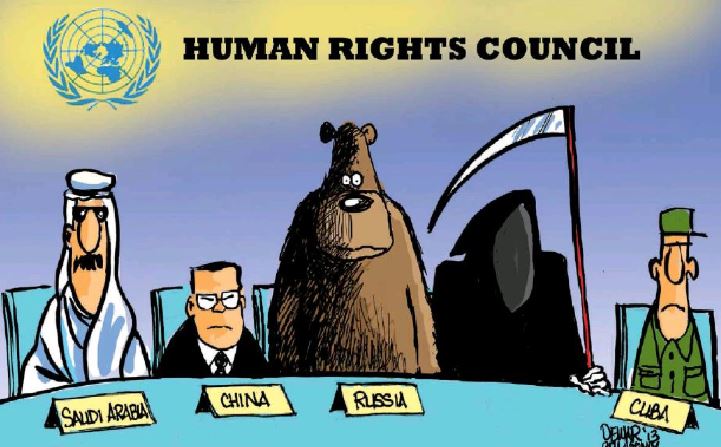
Another significant challenge to the enforcement of this warrant is that the Rome Statute is not universally accepted, and several countries, including Belarus, China, Cuba, India, Malaysia, Pakistan, Saudi Arabia, Sri Lanka and Turkey do not support the ICC, meaning Putin can freely enter these countries without fear of arrest. Further, some countries, namely the USA, have not ratified the Rome Statute, with many Senators being openly critical of the court, calling into question whether other countries would follow in suit in relation to this warrant. However, US President Biden said that the warrant:
“is justified, but the question is…it’s not internationally recognised, by us either, but I think it makes a strong point. He has clearly committed war crimes.”
In conclusion, this is a significant development in international law and geo-political relations. Whilst it is unlikely, at least in the near future, to result in a trial or any formal accountability, it has sent a strong message that the international community is still paying attention to the situation. As in many major conflicts and reprehensible situations, individuals can be held accountable years after the atrocities. In response to the warrant, Ukrainian President Volodymyr Zelenskyy has stated:
“[the] case has true prospect. The historic decision, from which historical responsibility will begin. The head of the terrorist state and another Russian official have officially become suspects in a war crime […] Over 16,000 cases of forced deportation have already been recorded. I am grateful for integrity and willingness to really bring to justice those who are guilty.”
International Criminal Court issues warrant of arrest for Putin. The historic decision, from which historical responsibility will begin. pic.twitter.com/cUW0WbeGKJ
The ICC is a permanent international criminal court established by the Rome Statute, a treaty which came into force in 2002 and has 123 state parties. The ICC’s mandate is to prosecute individuals responsible for the most serious crimes which transcend national boundaries. There are four broad category of crimes the ICC can prosecute:
Genocide – That being the specific intent to destroy a national, ethnic, racial or religious group by killing or inflicting conditions calculated to destroy.
Crimes against humanity – Those crimes which are serious violations committed against a civilian population, there are 15 specific crimes against humanity including murder, rape, enforced disappearance, slavery and torture.
War crimes – Which are grave breaches of the Geneva Conventions committed during armed conflict, these include attacks against hospitals, torture of prisoners of war, and the use of child soldiers.
Crime of aggression – That being the use of an armed force by a State against the independence of another State
The ICC is located in The Hague, Netherlands and is composed of four main organs: the Presidency, the Judicial Divisions, the Office of the Prosecutor, and the Registry. The Presidency is responsible for the overall administration of the ICC and is composed of the President (currently Judge Piotr Hofmanski) and two Vice-Presidents (currently Judge Luz del Carmen Carranza and Judge Antoine Kesia-Mbe Mindua). The Judicial Divisions are responsible for conducting the judicial proceedings, including pre-trial (the stage at which arrest warrants are issues), trial of defendants, and appeals. The Office of the Prosecutor is responsible for investigating and prosecuting crimes within the ICC’s jurisdiction. The Registry is responsible for the non-judicial aspects of the ICC’s work, including the administration of the court and the protection of victims and witnesses.
The International Criminal Court – The Hague, Netherlands
The ICC has jurisdiction over crimes committed on the territory of a state party to the Rome Statute, crimes committed by a national of a state party, or crimes referred to the court by the United Nations Security Council.
The ICC’s proceedings are based on the principle of complementarity, which means that the ICC can only prosecute crimes if national courts are unwilling or unable to do so. This is designed to encourage national authorities to take responsibility for prosecuting crimes committed on their territory and to ensure that the ICC only intervenes when necessary, this is why a great deal of states who may technically be engaged in the commission of offences such as war crimes will be unlikely to come before the ICC and why most referrals are from states which are struggling with the maintenance of their own nation.
The ICC’s proceedings follow a specific process, which begins with the Prosecutor initiating an investigation (the investigation into the 2022 invasion of Ukraine began almost immediately after the invasion). The Prosecutor can do this on their own initiative or based on information received from states, international organisations, or individuals, known as referrals. The Prosecutor then conducts a preliminary examination to determine whether there is a reasonable basis to proceed with an investigation, this includes viewing any evidence submitted to the office. If the Prosecutor decides to proceed, they will request the Pre-Trial Chamber to authorise an investigation.
Once an investigation is authorised, the Prosecutor will gather evidence and identify suspects. If there is enough evidence, the Prosecutor can request the Pre-Trial Chamber to issue an arrest warrant. Upon surrender or arrest, the suspects will then have an opportunity to challenge the charges and present their case at a trial, during the trial, they are detained in a special detention facility at The Hague. If found guilty, the suspects can be sentenced to imprisonment, fines, or other penalties. Due to its supranational standing, the ICC does not itself have a prison, and member states volunteer to house those sentenced by the ICC. Currently, the United Kingdom houses one ICC prisoner, former President of Liberia Charles Taylor, is detained at HMP Frankland
Throughout history, particularly in a country with such rich democratic and legal principles, laws have been created to establish order and protect citizens in all manner of circumstances. However, over time, some of these laws become outdated or irrelevant to modern society or society itself develops to such a degree where misinformation becomes commonplace. As a result, many legal myths emerge, but also, several strange laws continue to exist, even though they may seem bizarre or ridiculous.
Here are four of the most common legal myths and legends and four laws that you might be surprised still actually exist.
It is treason to put a postage stamp upside down on an envelope – FALSE
Probably the most common legal myth, one that is casually shared amongst lawyers and laypersons alike. It is popularly believed that placing a postage stamp, with the Queen’s face upside down, onto an envelope is a clear act of treason.
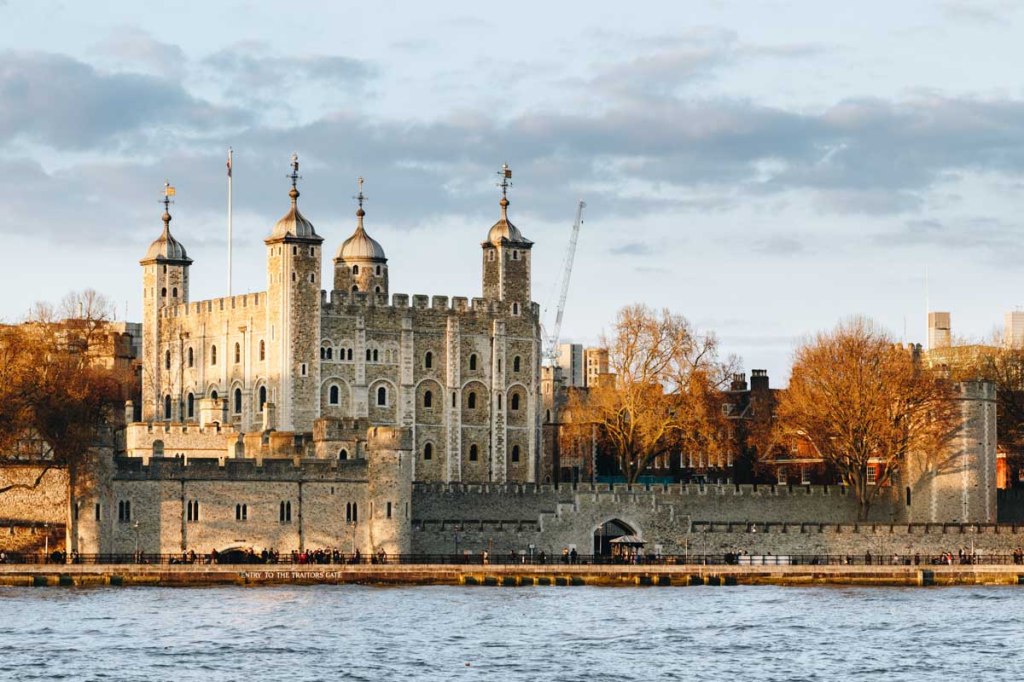
Unlike some of the legal myths on this list, it is easy to see where this confusion came from and it has a clear sequence in history. Under the Treason Act 1351, it was an offence punishable by death by being hung, drawn, and quartered (for men) or burned (for women), to ‘counterfeit the Great Seal or the Privy Seal’. The death penalty element of this offence was repealed by virtue of s.2 of the Forgery Act 1830, with the rest of the offence continuing. This offence was again restated in s.1 of the Forgery Act 1861 before finally being repealed and re-enacted in s.5 of the Forgery Act 1913 which states that it is an offence punishable by life imprisonment ‘to forge with intent to defraud or deceive the Great Seal of the UK’ or ‘His Majesty’s Privy Seal’, this provision is still fully in force today.
However, and this is a big however, in none of these Acts was it ever stated that this applied to the image of the Crown or any postage stamps.
It is illegal to wear a suit of armour inside the Houses of Parliament – True
After substantial turmoil in the early period of Parliament, namely coming from the King’s advisors continually seeking to take greater power away from the Crown, there was significant risk towards and between the members of what was then the Commons. This was particularly rife during the early reign of Edward II.
Following an armed march on London, and attendance at parliament, by nobles and magnates in 1312, including the Earl of Lancaster, the 1313 Statute Forbidding Bearing of Armour banned the wearing of armour and ‘coming with force’ to parliament.
Whilst there have been no such prosecutions under this enactment in recorded history, it technically remains on the statute book and has not been repealed in any way. Additionally, despite human rights principles, it is likely that banning the wearing of defensive armour inside such a significant place, would actually be lawful under the European Convention as pursuing a legitimate means in a proportionate way.
It is legal to shoot a Welshman with a longbow within the city walls of Chester – FALSE
Of course, it is entirely nonsense that this is lawful, however, this does not stop this ‘legal fact’ from being brought up anytime a Welsh person is around. The origin of this law is not entirely clear, however, there is a strong theory that it relates to the Prince of Wales. During the Battle of Shrewsbury in 1403, famous knight Sir Henry “Hotspur” Percy (from whom the football club is named after), was killed after defecting to the Welsh side, fearing an outbreak of sympathisers and further defections, Prince Henry as he then was, decreed that:
“[A]ll manner of Welsh persons or Welsh sympathies should be expelled from the city; that no Welshman should enter the city before sunrise or tarry in it after sunset, under pain of decapitation”
However, this decree, if it ever had full legal force at all, was very short lived indeed. Only five years later in 1408, John Ewloe, a Welshman, was elected as the mayor of Chester…putting to rest that the decree held any level of force.
Despite this, even if the decree had full legal force and had not been formally repealed, this would still hold no legal value as, in every aspect, newer laws have been put in place superseding any allowance for the killing of Welshmen.
It is illegal to drive cattle through the streets of London during the day – True
A legal truth which sounds beyond any sense or logic. It is, in fact, still a crime to ‘drive or conduct any cattle’ through the streets of London between 10am and 7pm, that is, of course, unless the person doing such driving has the permission of the police Commissioner; Sir Mark Rowley may be slightly too busy to grant such permissions, however.
The Metropolitan Streets Act 1867 has seen several amendments aimed at repealing irrelevant sections in the past 70 years, however, s.7, specifically banning the acts mentioned above, has never been repealed. Interestingly, the section was amended to remove a word in 1993, yet parliament at the time did not feel the removing of the whole section was relevant…There must have been a serious bovine problem in London at the time?
You can still be sentenced to death for committing an act of treason – FALSE
Following the theme of misconception number 1, it is a common belief that if you are convicted of treason that you can still be sentenced to death. This was the case up until 1998, fortunately nobody was ever tried for treason between WWII and this period as a multitude of issues would have arisen under the European Convention on Human Rights. Section 36 of the Crime and Disorder Act 1998 formally abolished the death penalty in respect of any offence of treason in the United Kingdom.
“Where else would one get drunk if not a pub?”, one might think. However, the law has a different opinion here. Whilst the vast majority of the Licensing Act 1872 was repealed, s.12 remains in full force and states that ‘Every person found drunk in any highway or other public place, whether a building or not, or on any licensed premises, shall be liable…’.
Whilst this seems archaic and, for lack of a better term, backwards. The CPS have routinely brought prosecutions under this section at an incidence of around 600 per year (though there is no data which of these relate specifically to licensed premises).
What is perhaps more interesting is that, under s.143 of the 2003 Licensing Act, a similar offence exists. This section makes it an offence to not leave a licensed premises if drunk having been asked to do so by a police officer.
It is illegal to drive barefoot or in flip-flops – FALSE
The amount of legal misconceptions and myths surrounding driving are rife, but very few quite reach the level of notoriety as the footwear myth. This legal myth is not isolated to the UK, many countries perpetuate a similar myth, leading Jason Heimbaugh to write to the DMV in each of the 50 US states in the 1990’s to seek clarification, all of them confirming that no such law exists.
Like most legal urban legends, it is not clear where this myth comes from or where it starter. It is likely that the common practice of driving in suitable footwear became so commonplace that many accepted this as law and thus stated as such.
Whilst it is not illegal in the UK, Rule 97 of the Highway Code does state that all drivers “should ensure that clothing and footwear do not prevent you using the controls in the correct manner’. It is possible that driving barefoot of in flip-flops may not always be suitable, but it is certainly not illegal.
You cannot fire a cannon within 300 yards of a house – TRUE
This law, which makes more sense than most on this list, is strange simply by the fact it exists. The firing of cannons to the annoyance of individuals trying to live their lives must have been such a big problem in London, that in 1839 Parliament passed s.55 of the Metropolitan Police Act, making it an offence to discharge any cannot within 300 yards of a dwelling house.
Tchaikovsky fans will be saddened. However, the penalty for this very specific offence, is simply a level 1 fine. As such, for the low price of £200 per shot, you can annoy your neighbours with cannon fire as much as you like*
*Whilst this specific offence is minor, you would inevitably commit no fewer than 6 other offences in procuring a cannon, gunpowder, and discharging said cannon, as such, this is not formal legal advice…
Artificial Intelligence (AI) has revolutionised various industries and sectors, and the legal system is no exception. In recent years, AI technology has been introduced to the English legal system, which has provided a range of benefits and potential drawbacks. In this article, we will explore the advantages and disadvantages of AI in the English legal system, and what the future may hold for this innovative technology.
Benefits of AI in the English legal system
The use of AI in the English legal system has already produced significant benefits. One of the most significant advantages is efficiency. By automating tasks such as document review and analysis, AI can save lawyers and their clients’ significant amounts of time and money. In addition, AI can help to reduce errors and increase accuracy in legal work, which is essential in a field that is heavily reliant on meticulous attention to detail.
Another benefit of AI in the English legal system is its ability to help identify patterns and trends in data, which can aid lawyers in building stronger cases. By analysing vast amounts of data, AI can identify patterns that might otherwise be missed by human lawyers, which can help to build a more compelling legal argument.
AI can also help to enhance access to justice, particularly for those who cannot afford legal representation. By automating some legal services, AI can help to make legal services more accessible to a broader range of people.
Negatives of AI in the English legal system
While there are many potential benefits to using AI in the English legal system, there are also potential drawbacks. One of the most significant is the risk of bias. AI is only as unbiased as the data it is trained on, and if that data is biased, then the AI will be as well. This can lead to unfair outcomes, particularly for disadvantaged groups.
Another potential negative of AI in the English legal system is the risk of errors. AI technology is still relatively new, and there is always a risk of errors or malfunctions. In a field as critical as the legal system, even a small error can have serious consequences. Finally, the use of AI in the English legal system raises concerns about the future of the legal profession. Some worry that AI will eventually replace human lawyers, leading to widespread unemployment and a loss of human expertise in the legal field.
The future of AI in the English legal system
Despite these concerns, the future of AI in the English legal system looks promising. As the technology improves and becomes more sophisticated, it is likely that the benefits of AI will only continue to grow. AI can help lawyers to work more efficiently, accurately, and quickly, which can lead to better outcomes for clients.
However, it is crucial to remember that AI is not a magic bullet that can solve all the challenges facing the legal system. It is only one tool that can be used in combination with other strategies to improve the legal system. As AI technology continues to evolve, it will be important to ensure that it is used in a responsible and ethical manner, with a focus on ensuring fairness, accuracy, and transparency.
Conclusion
In conclusion, the use of AI in the English legal system has both benefits and potential drawbacks. The benefits include increased efficiency, accuracy, and access to justice. However, there are also potential negatives, including the risk of bias and errors, as well as concerns about the future of the legal profession.
Despite these concerns, the future of AI in the English legal system looks promising. As the technology continues to improve, it will be important to ensure that it is used in a responsible and ethical manner, with a focus on ensuring fairness, accuracy, and transparency. By doing so, we can harness the power of AI to improve the legal system and deliver better outcomes for everyone.
Editors note
This article, including the awfully punny title, was written by OpenAI’s ‘ChatGPT’ after being given the prompt “Write an 800 word article about the benefits, negatives, and future of AI in the English legal system”. This article was produced in 3 minutes. The only edits made were stylistic and correcting two words originally in US English. It is both fascinating and revolutionary on one side, but exponentially terrifying on the other.AI, as the AI has stated, presents many positives and routes for development and is liable to vastly increase access to justice for those otherwise unable to afford a solicitor or barrister. But, there is ever increasing risk, we have seen the damage that the internet can cause with the rise of conspiracy theories, extremism, and misinformation, there is no reason to suggest it would be any different in the context of the legal system.
On the 16th January 2023, in an attempt to further wage its destructive campaign against workers rights and trade union strength, the Government substantively introduced the Strikes (Minimum Service Levels) Bill.
The Government has, for many months now, stated they will introduce legislation to curb the impact that trade unions can have through their power to lawfully strike. The Strikes Bill seeks to do this through giving the Government the power to introduce minimum service levels in selected industries through secondary legislation.
The Bill, as it stands, has several significant impacts.
Minimum Service Levels
The Bill would amend the Trade Union and Labour Relations (Consolidation) Act 1992, considered by many to be one of the most fundamental pieces of labour relations legislation in recent years, in that it would create a power for the relevant Secretary of State to implement minimum service levels over a number of industries should members of those industries seek to strike. It is important to note that the Bill itself does not state the minimum level, it simply creates the ability for the Government to implement this later; the Government would be able to change the minimum service level and implement this through such a procedure easier than they would through the standard procedure for implementing legislative change much more easily.
The industries that would be impacted are:
Health services – It is worth noting that, the Bill does not specifically state the NHS, as such, it is possible that this industry could be so broad as to include care homes, charitable drug rehabilitation services, and private medical centres. This would impact at least 1.3 million employees, but depending on the scope of the definition, could be much greater.
Fire and rescue services – This would include all 53 fire and rescue services across the UK, which currently comprises over 40,000 staff.
Education services – This would impact teachers across the spectrum, from nursery to university, public or private. Additionally, it would impact all ancillary staff in the education sector such as admin and support staff. This would impact roughly 1.5 million employees.
Transport services – Obviously aimed towards train staff following the ongoing RMT dispute, this industry would also encompass innumerable additional employees working on trams, the tube, buses, coaches, and again depending on the scope, possibly those working in the aviation industry. It is difficult to state how many people this would impact; however, it is likely to affect not fewer than 500,000.
Decommissioning and radioactive waste – A niche sector to include in the Bill, this would primarily impact those working at nuclear sites across the UK such as Sellafield but would also impact those actively decommissioning the 13 sites across the UK and could also impact many in the private sector. This could impact around 100,000 employees in this sector.
Border security – This industry has the possibility to be extremely broad, it will undoubtedly impact all employees working for Border Force but could go much wider and impact admin and support staff and also private firms providing security to ports and airports across the UK. This would impact a minimum of 10,000 but the number could be much greater.
Work Notices
Following the relevant Secretary of State implementing a minimum service level, an employer within that industry can issue a ‘work notice’ to a trade union in respect of any strike that may be upcoming. This would give the union notice that the employer expects that minimum service level to be met despite the strike. In particular, the employer can specify the exact type of employee and the roles that they do.
The Bill provides that these work notices can be issued as close to a strike as 7 days before it begins. Whilst the work notice must not identify more people than reasonably necessary, this does little to ensure the power will not be woefully abused.
The Bill does state that the employer must consult with the trade union before issuing a work notice but provides no sanction for failing to do so and does not require the employer to put into place anything expressed by the union. In practical terms, this means the employer must give the union a chance to express their opposition but do nothing further.
Further, the employer can further vary this work notice with as few as 4 days’ notice before the strike is to begin.
Unions Liability and Workers Rights
The Bill will make it such that if a union acts in any way against a work notice i.e. strikes to a degree that takes the service level below the minimum level stated in the regulation, the union will be liable for losses suffered by the employer. The law would require the union to take reasonable steps to ensure that those members identified in the notice comply.
Further, the Bill makes it so that any employee who engages in a strike contrary to the work notice, is not protected in respects of unfair dismissal. Essentially, an employee may be risking dismissal for taking part in strike action against any work notice.
“People are dying unnecessarily in the National Health Service because of a decade of cuts and life-threatening austerity. So right now the government isn’t delivering minimum service levels. Not because of strikes by ambulance workers but because the government has created this crisis.”
Power to Regulate
As mentioned above, the Bill would grant the relevant Secretary of State a power to introduce secondary legislation, known as a Statutory Instrument, that would set the minimum service level. This power is extremely broad and is essentially unable to be beaten down by Parliament.
“The reason the Bill is so short is that it delegates to the Secretary of State the power to set out all the relevant law in regulations through statutory instruments—regulations which receive only the most minimal scrutiny in this place and cannot be amended. So it is the Secretary of State, not Parliament, who will make regulations to determine the levels of service in relation to strikes”
In the 2000 document, A House for the Future, the Royal Commission noted significant problems with legislating through Statutory Instruments. Most notable were that such legislation cannot be amended by Parliament, they can either choose to approve or reject the SI and ‘As they rarely raise major issues of principle, there is a natural reluctance to go to the length of rejecting the whole Instrument’.
Even more worryingly, the Bill includes a provision that the Secretary of State has the power to “amend, repeal or revoke provision made by or under primary legislation” under these secondary legislative powers. These are known as Henry VIII clauses and are an extremely dangerous provision, they allow the Government to change primary Acts of Parliament which go through significant scrutiny, through a procedure which is devoid of such scrutiny. SNP MP, Owen Thompson has stated that these powers:
“Enabling Ministers to amend, repeal or revoke primary legislation not yet passed, should chill the heart of any democrat.”
These powers would allow the Government to change any future legislation that is passed by Parliament in the current session, it, on an extreme explanation, removes the need for Parliament. Regardless of what laws Parliament implement or change, the Government would be empowered to turn around and simply state that they don’t like it, they want to change it, or want to revoke it, and then simply be able to do it.
During the initial debate, numerous MPs stated that these powers were a direct attack on democracy.
“[the Bill] tells us little about how the legislation is intended to work. It also tells us that the government itself has little idea of how the legislation will work.”
It is likely that, as it stands, and despite the Government’s declaration, the Bill would be an infringement of the European Convention of Human Rights due to its significantly broad and disproportionate power. However, this Government has shown little regard for the ECHR in recent times.
Should this Bill pass into law, it will mark a point of no return in the history of trade unions and workers rights, rights which have been fought for over hundreds of years.
In recent years there has seemingly been an increase in the labeling of individuals as anti-Semitic. This increase comes alongside other ‘isms and ‘ists being applied to all manner of things. What is interesting to note, however, is that much of the time when a person is labelled as such, these labels are not necessarily applied by individuals of that group or indeed by any prominent voices in said group. Rather, the labels are applied by a series of ‘woke’ and potentially overly-liberal voices, often online, in response to perceived ‘isms.
Now this is not to say that many of these acts or comments do not fall into these categories, however, it is hard to argue that every single case of individuals being labelled as racist, sexist, transphobic, anti-Semitic etc. can truly fall into these categories. It is worth noting that I am a white male with no real ethnic or religious background to speak of, and so my comments of course come from a place of objective ignorance as I have never personally experienced many forms of prejudice. This being said, there must surely be an objective standpoint that can be taken, even for an individual outside experiencing such prejudice personally.
I find it hard to reconcile that simply calling out a state that just so happens to be founded on, or comprised significantly of individuals following Judaism must relate to that fact. For example, one can report bullying without that report having anything to do with the personal characteristics of that bully. And so, we must surely be able to bring attention to, and indeed criticise Israel for the clear and abhorrent violations of human rights and humanitarian law without fearing reprisals over whether or not we are criticising Jewish people or Judaism as part of that debate.
The fear of offending, indeed even perceived offending where such offence may not actually exist, has a serious effect on stifling debate. Where we choose to not report on or call out Israel for violations of international law because we are scared that we may be perceived as anti-Semitic or racist results in serious and unforgivable acts going unchecked and unquestioned. We must be able to separate out this debate, we must be able to see that a comment on Israel is not a comment on Judaism.
Reporting on the atrocities committed by Israel and questioning the entire situation does not make a person anti-Semitic, however, it cannot be ignored that, in the wake of such atrocities, anti-Semitism does in fact increase along side these issues (see more). Such occurrences should not be allowed and should equally be called out.
We must not lose sight of the fact that human lives are currently being taken in indiscriminate bombings, the lives of children, innocent individuals, and recently journalists and members of the free press. This should not be a debate over what we should and should not be allowed to say, rather, it should be a debate on what action the world community needs to see taken in response to these violations!
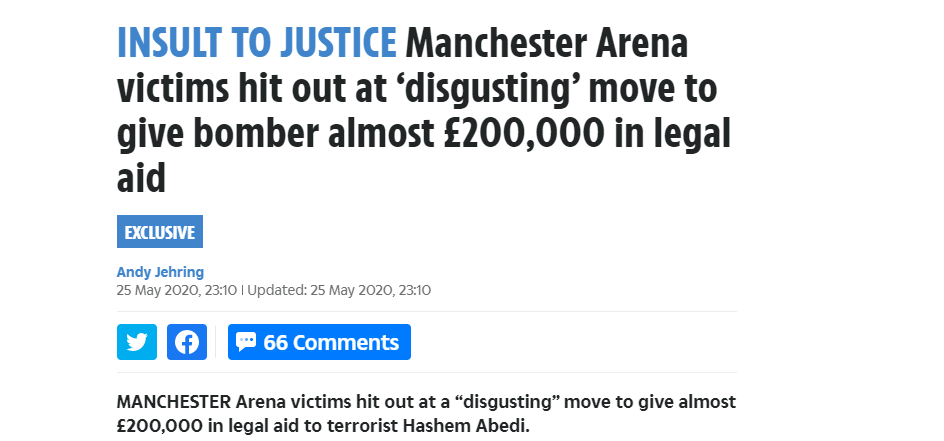
Legal Aid has formed the subject of many news articles
Legal Aid is one of the most contentious issues in politics and journalism. Surprisingly, Legal Aid is not in fact very contentious in the legal world, because, unsurprisingly, lawyers understand how legal aid works and why it works in the way that it does. I won’t seek to assume any knowledge about the law in this blog, nor will I be heavily relying on the law itself.
Legal Aid was first officially established in 1949 and saw its last major overhaul in 2012. Prior to legal aid, many individuals had to fight an uphill battle, especially those in the criminal courts. The Crown (better understood as the state) is ALWAYS represented by a lawyer in criminal trials and hearings, this is via the Crown Prosecution Service. Defendants, however, do not always have legal representation, this was especially the case many years ago.
So, imagine being accused of a serious offence, for example, murder. You know you did not commit this crime, but there is ample evidence that points to you being the one who is very likely to have commit the murder. Now imagine you receive state benefits, you have no savings and no financial support from others, you cannot afford a lawyer and you have no understanding of the law. What are your options? Before legal aid, you would have to act ‘pro se’ meaning you would act as your own lawyer. You, an untrained individual with no legal knowledge, would have to effectively argue your innocence against a fully trained lawyer with an intimidating gown and wig, before an intimidating court being watched by strangers. In all likelihood, you are going to lose this fight.
This is where Legal Aid now steps in. The state will fund a legal representative (be that a solicitor or barrister, or likely both) in order to defend you. This person has a duty under the law to defend you no matter what (almost). This person has effectively taken an oath to provide the best advice and support that they can in order to give you a fighting chance, because, in the United Kingdom, if you state that you are not guilty, we do not assume that you are until a jury state otherwise.
So far this should seem pretty uncontroversial, if somebody is wrongly accused of an offence then they should be represented fairly. The issue is, how do we know who is wrongly accused? Because every person is technically innocent until a jury of 12 ordinary citizens decide otherwise. The fact of the matter is, we simply do not know. It is impossible to know, that is the entire point of a trial, to determine guilt or innocence. Everybody must therefore be given the same chance to argue their case and every person must be held innocent until proven otherwise.
Now let us imagine that you are a career criminal, you have committed 25 burglaries over your life, however, you have now taken a new path in life and are trying to move past crime; however, your next door neighbour is burgled and you are accused and charged. Do you deserve to be represented? You committed the other 25 so surely you MUST have committed this one? A jury may in fact be even more inclined to find you guilty based solely on this fact alone. It is clear to see how in such a case the defendant may be in even more need of legal representation than a person falsely accused for the first time. A person’s past mistakes should not mean they are tried without just cause or representation.
If we existed in a society that prevented people from receiving the best legal representation they need, no matter the cost, then a system develops where a person has charges added on that they did not commit, simply because the state can. A person can be accused of a crime that is similar in nature to offences they have committed in the past just so the state can make their conviction rate appear better. A person with severe mental illnesses can be charged, tried and sentenced for something they have no way of understanding. Evidence can be made-up, hidden or twisted in a way that leaves a defendant without a way to argue their case. If an individual does not have a lawyer, then anything could happen. In the same way that we do not allow individuals to operate on themselves when they require medical attention, we provide a trained surgeon via the NHS.
Even if you don’t believe that ‘bad’ people should have the same defence as ‘good’ people, you should still fight for legal aid. Imagine that a serial killer is accused of a 5th murder, imagine he did not actually commit the murder, but because he is ‘bad’ it does not matter and “he deserves the extra time in prison” and “he should not have committed the other 4 murders if he didn’t want to be labelled in such a way.” But, what about the 5th victim and their family, and their friends, and the public? If our serial killer is not represented and is found guilty, all because he is a ‘bad’ person, then the real killer is left to be free, the public are still at risk, the family never gets true justice. Lawyers must be able to defend ALL individuals from ALL accusations, otherwise, the ‘standard of proof’ is lessened for some offences and the state is able to more easily convince a jury to find a person guilty.
Empathy is a difficult emotion to display towards people who have been accused of awful crimes, but just imagine you are in their shoes and you didn’t commit the offence. You would want the best legal representation.
Accused does NOT mean guilty.
Being charged with an offence does NOT mean that the offence was committed by the person charged.
Going to court does NOT mean that what is said in that court is true.
Even if a person does the physical act that is stated, that does not mean they are guilty of a criminal offence. The law is a very complex thing. Legal practitioners’ study for at least 5 years to understand these issues and even then, it takes years to develop a high degree of understanding in a specific area.
EVERYBODY must have the best legal representation available to them otherwise it is a very steep slope towards an authoritarian regime where anybody can be found guilty simply by accusation. We must defend those who are most ‘undeserving’, we must defend those who are accused of committing the most heinous, evil and disgusting acts, we must defend the ‘indefensible’. To not do so allows for a slow, but sure, encroachment onto all of us. Today we become lax towards defending serial rapists, tomorrow we become lax towards defending mentally ill individuals, next week we become lax towards defending children accused of theft, next month we become lax towards defending whistle-blowers and political campaigners, next year we are unable to begin taking back our rights because we so fiercely argued to strip those we didn’t like of theirs.
On a final side note, legal aid is never a cash payment to the defendants themselves. It is simply the amount that all the work conducted by every person involved in the individuals case has come to; there is no transfer of funds to individuals charged with a crime.
Avaia Williams – Founder
*This blog was produced in response to several articles published by ‘The Sun’ and ‘The Daily Mail’ newspapers regarding legal aid, specifically the recent case surrounding PC Andrew Harper.
Welcome to the very first blog post from the Nightingale Rights Initiative.
Thank you for taking your time to visit our site and for taking an interest in the work that the NRI is doing. Be sure to check out our social media links at the top of each page and if you are interested in joining the NRI team then see the ‘Join The Team’ button on the Home page.












 Nightingale Rights Initiative