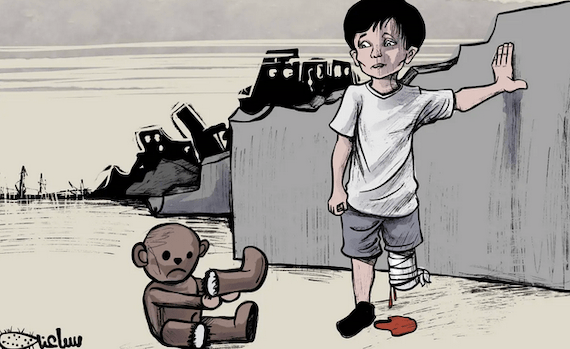
A toy dump‑truck lies half‑buried in rubble outside what used to be a nursery in northern Gaza. Eight hundred kilometres away, faded chalk drawings still cling to the bomb‑scarred walls of a primary school in Kharkiv. The details differ, but the story is the same, wherever adults wage war, children inherit the ruins.
The United Nations verified 41,370 grave violations against children in armed conflicts during 2024 alone. a figure so large it hurts just to process, yet each number has a name, a personality, and an abruptly altered future.
The Gaza Strip offers one of the starkest portraits. Since 7 October 2023, UNICEF reports more than 50,000 Palestinian children have been killed or injured, the report noting:
“How many more dead girls and boys will it take? What level of horror must be livestreamed before the international community fully steps up, uses its influence, and takes bold, decisive action to force the end of this ruthless killing of children?”
Hospitals turned field camps struggle to do more than triage given antibiotics run out before the bandages. A starkly reported statistic reveals that, in Gaza, there are more child amputees than anywhere else on earth, meaning that instead of reaching for toys, crayons, or textbooks, toddlers are waking after surgery and reaching for legs that are no longer there. The psychological picture is just as damaging, research from Mohsen Khosravi summarising that:
“These children often endure a range of traumatic experiences, including witnessing violence, losing family members, and being forcibly displaced from their homes. Such experiences can lead to a variety of psychological issues, including post-traumatic stress disorder, depression, anxiety, adjustment disorders, psychosomatic symptoms, behavioral problems (e.g., aggression, withdrawal, and difficulties in social interactions), suicidality, and developmental delays.”
Yet with only around 30 psychiatrists in occupied Gaza, and no functioning mental health centres remaining, the emotional future of the children of Palestine has likely already been failed.
Cross the Black Sea to Ukraine and the landscape changes, but the hazards remain familiarly lethal. A report from the UN Human Rights High Commissioner reveals that children in the annexed regions of Ukraine have faced significant violations, including summary execution, sexual violence, torture and forced transfer. The same report lists that 669 children have been killed and 1,833 injured between February 2022 and December 2024; recent missile salvos have pushed this figure even higher.
Families flee east and west in great waves, with UNICEF reporting that some 4.3 million children being displaced within the first month of the war, almost 2 million of those becoming refugees. As part of the ICC warrant issued in 2023, charges of deportation and unlawful transfer of children from Ukraine to Russian were laid.
Inside Ukraine, Save the Children notes that three years of full-scale war has shattered the lives of children, reporting that:
“Three years of full-scale war in Ukraine has shattered children’s lives. Their childhoods have been ripped away as they’ve been forced from their homes and schools, lost loved ones and friends and lived in fear as air raid alerts, drones and explosions consume the world around them. From children living on the frontline of the war to those who have been displaced from their homes, the scale of loss is catastrophic.”
Numbers can obscure the lived texture of such childhoods, paradoxically so when those numbers move into the tens of thousands. Liliana, an 18-month old baby was presented dead to US doctors in Gaza, a bullet wound to her temple. Mira Abd Radwan (0) had not even reached her first birthday, Ayla Abu-Al-Aish (1) was unable to take her first steps, Saeed Al-Ramlawi (4) never got to reach pre-school and Aisha Al-Shawa (11) survived three wars before falling in the fourth – these are not even a fraction of the 11,500 currently listed on Al Jazeera’s “Know Their Names” page.
Twins Denys and Nikol Deineko (1) left the world as they came in to it, together, and Liza Dmytriieva (4) was killed in an airstrike whilst walking with her play pushchair. Alisa Perebyinis (9) will never see her tenth birthday due to Russian mortars and Rostyslav Pichkur (13) had only recently reached his teens before being targeted by a T-72 tank; these being just four stories shared by families in Ukraine.
International law, on paper, could not be clearer. The Convention on the Rights of the Child demands that states protect children from violence and guarantee access to health care and education. The Rome Statute empowers judges in The Hague to prosecute commanders who deport children or shell playgrounds. More than 120 countries have endorsed the Safe Schools Declaration, committing to working together to safeguard schools from military use and target during conflict. Israel and Russia remain notable hold‑outs, and signatures, in any case, are only as powerful as political will makes them.
Yet even amid diplomatic stalemate, interventions can change trajectories. Providing windows of relative calm, whether a week‑long humanitarian pause or a specific corridor agreement, allows surgeons to perform complex reconstructions, prosthetists to fit growing bodies with adjustable limbs, and counsellors to teach families basic coping skills. The lesson is brutal but straightforward: access saves lives.
What happens once the guns fall silent? History suggests the wounds of childhood outlast the treaties that end wars. Maja Pašović, who was only five when the war in Bosnia broke out, spoke out at the start of the 2022 Russian invasions, stating:
“For child survivors, including me, the collective trauma that armed conflicts wreak upon a population can take years to heal. For many, these wounds never heal. Countless people from my hometown and my generation have never escaped the emotional scars of war, not to mention the other damages it inflicted on them by restricting their access to education, social bonding, and health care. When I remember my schoolmates and neighbors from Sarajevo, I often wonder how many of them are reliving this trauma of war, a war that may have detrimental impacts globally, if peace and stability are not realized soon.
Healing the traumas of war is a continuous and difficult process, requiring years of work, patience, and perseverance.”
Shielding children from war cannot wait for peace treaties; it requires a chain of safeguards stretching from the battlefield to the negotiating table and back. It starts with ceasefire deals that put children’s safety—medical evacuations, food convoys, power for incubators—on equal footing with territorial demands. It continues with budgets that reserve real, traceable money for rebuilding classrooms, fitting prosthetics and training counsellors, because recovery is impossible if children grow up ill, uneducated or traumatised. It is reinforced by investigators who document every shell crater and forced deportation so that future courts can speak for victims too young to testify today. And it matures when every army, rebel group and security force treats schools and hospitals as off‑limits.
All of this costs money and, more critically, political capital. But the alternative future is much more costly and results in a future in which today’s traumatised children rebuild their broken cities only to inherit their parents’ grievances. Measured by that, Gaza and Ukraine indict us all. The rubble outside a nursery and the chalk ghosts on a classroom wall are not only symbols of loss but also of a promised better world. Whether that promise is renewed or abandoned will depend on choices made far from any frontline, in conference halls where children have no voice.
We owe them more than a place on someone else’s agenda; we owe them the right to live a childhood unpunctuated by sirens.
Postscript – Beyond Gaza and Ukraine
The wars examined above are only two threads in a far wider tapestry of violence that frays childhood around the globe. In Sudan, renewed fighting in Darfur and Kordofan has uprooted nearly seven million children and placed entire towns under siege. Across West Papua, children are regularly targeted with claims of being guerrilla rebels. Syria’s boys and girls face a second decade of war amid collapsing health systems and playgrounds littered with unexploded ordnance. In Myanmar, thousands of children have been recruited as soldiers with over 2000 grave violations committed. Protracted crises in Yemen, Ethiopia’s Tigray, the DRC, and gang‑violence‑torn Haiti generate equally grim tallies of malnutrition, displacement and lost schooling. Every one of these conflicts echoes that, when adults fight, children lose.

Avaia Williams – Founder
This blog was published on Saturday 19th July 2025
 Nightingale Rights Initiative