Last week, the High Court upheld the right of jurors to acquit defendants according to their conscience and that it is not a contempt of court to inform jurors of this right, firming the principle of jury nullification – a power often overlooked, in fact, a power often unknown by many, but deeply embedded in the legal landscape. Jury nullification, also known as a perverse verdict, is when a jury believe that the defendant is guilty of the offence with which they have been charged, but find them not guilty anyway, most usually do to a sense of a moral wrong having been committed by charging the person to begin with.
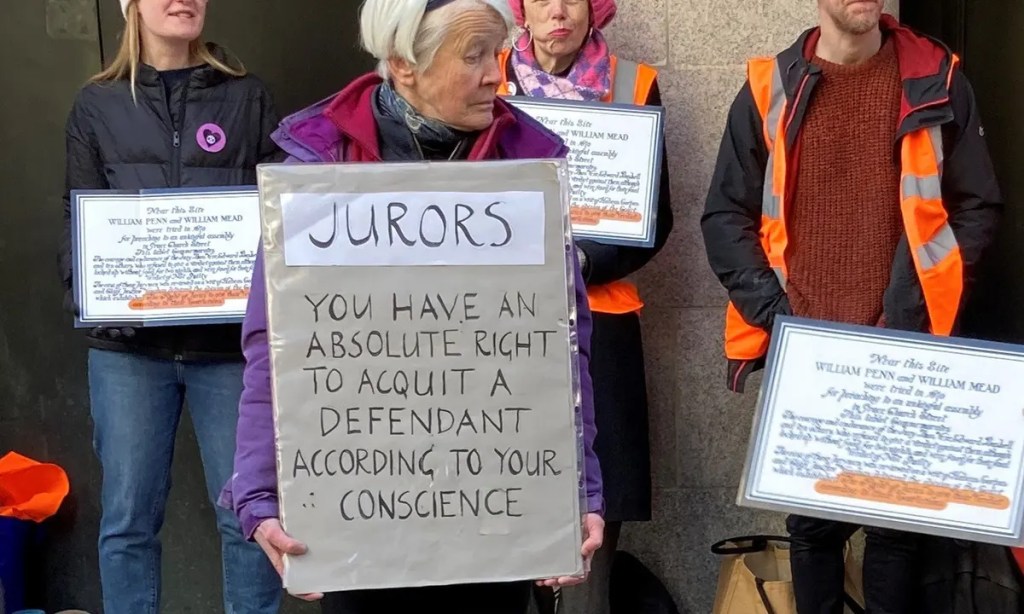
The case before the High Court centered around Trudi Warner, a former social worker, who faced prosecution for holding a sign outside the trial of climate activists, advising jurors’ of this right. Miss Warner sat outside the Inner London Crown Court, during the trial of members of Insulate Britain, holding a sign bearing the epigram:
“JURORS YOU HAVE AN ABSOLUTE RIGHT TO ACQUIT A DEFENDANT ACCORDING TO YOUR CONSCIENCE”
The Solicitor General sought to prosecute Warner for contempt of court, alleging that her actions interfered with the administration of justice by encouraging jurors to disregard judicial directions and decide according to their conscience, rather than the law. However, Mr Justice Saini dismissed the claim, emphasising that Warner’s placard merely informed jurors of their inherent right to acquit a defendant based on their conscience—a principle which first entered the landscape following Bushel’s Case in 1670, where a judge ordered a jury to find a defendant guilty, the jury refused and were imprisoned; the Court of Common Pleas held that a jury had the right to give their verdict according to their convictions.
Interestingly, a plaque sits inside the Old Baily, where the most serious criminal cases are tried, that bears the details of Bushels Case and notes that jurors have such a right. A matter which the High Court noted:
“Overall, in my judgment, the claim is based on a mischaracterisation of what Ms Warner did that morning and a failure to recognise that what her Placard said outside the Court reflects essentially what is regularly read on the Old Bailey plaque by jurors, and what our highest courts recognise as part of our constitutional landscape.”
In concluding the Judgment, Mr Justice Saini noted that:
“…it has not been shown by the Solicitor General, even on an arguable basis, that the interference with Ms Warner’s Article 10(1) ECHR rights is necessary for, and proportionate to, achievement of those aims. The words on Ms Warner’s Placard reflected in substance what is recognised as a principle of our constitution. However, even if her words had been wrong in law and her conduct inappropriate, the succinct Direction given by the judge was sufficient to deal with any prejudice to the trial. A criminal prosecution is a disproportionate approach to this situation in a democratic society.”
Moving forward, this ruling serves as a crucial precedent, affirming the legitimacy of jury nullification as a safeguard against injustice. It recognises the moral agency of jurors and their role as guardians of fairness in the legal system. Moreover, it highlights the importance of public awareness and education about jurors’ rights and responsibilities. The law is written by Parliament who are the peoples representatives in the House of Commons, it is only right that the people themselves can therefore decide a law itself is not just, and return a verdict according to their conscience.
The principle has been seen, or at least assumed, to have been employed in several recent cases where climate change protestors have been acquitted, albeit in the face of overwhelming evidence that they had committed the offences with which they had been charged.
In such cases, jury nullification serves as a form of civil disobedience, challenging unjust laws or government actions perceived as morally reprehensible. By acquitting defendants aligned with righteous causes, juries send a powerful message about the limits of state authority and the primacy of individual conscience.
Critics may argue that jury nullification undermines the rule of law and erodes respect for legal institutions. However, it is more arguable that this right upholds the very foundational principles of the Rule of Law. It is a necessary check on state power and a safeguard against tyranny. It allows ordinary citizens to resist unjust laws and uphold higher moral principles, reflecting the democratic ethos of a society.
Moreover, jury nullification reflects the evolving nature of legal norms and societal values. As attitudes towards issues like climate change, social justice, and civil liberties evolve, so too may jurors’ perceptions of what constitutes just verdicts. In this sense, jury nullification serves as a dynamic expression of popular sovereignty and collective conscience.

Avaia Williams – Founder
This blog was published on 28 April 2024
 Nightingale Rights Initiative