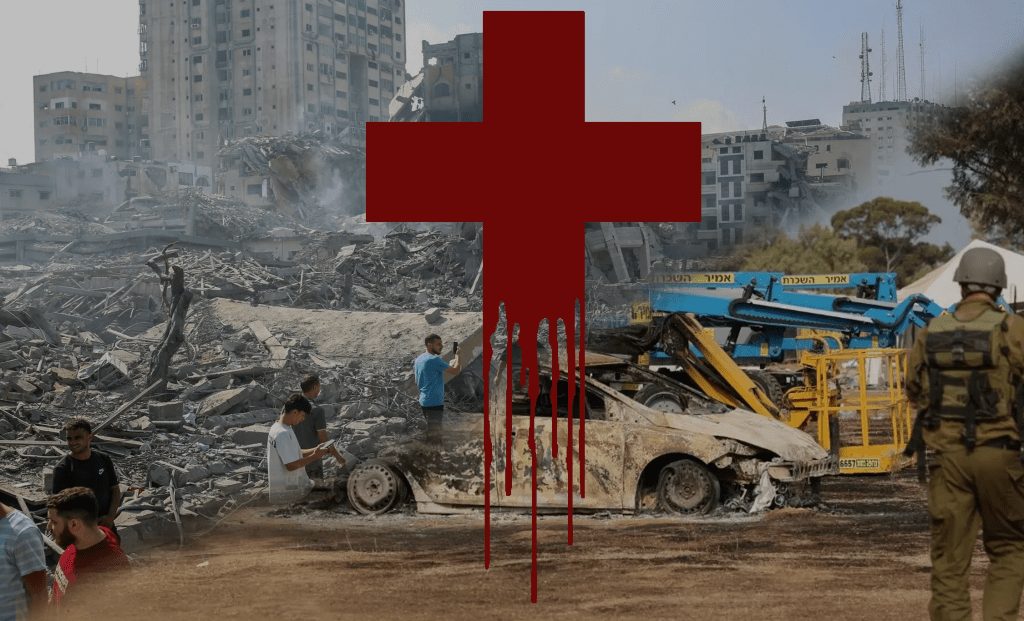
Armed conflicts have been a grim and enduring feature of human history as well as current affairs. In the midst of the chaos and devastation that war brings, certain principles and rules have emerged to provide a glimmer of humanity and to minimise the suffering endured by civilians and combatants alike. Among these rules, which are vast in number and scope, five stand out as fundamental to the conduct of warfare. These rules are guided by the Geneva Conventions and customary international humanitarian law. These rules aim to uphold the principles of distinction, humane treatment, and protection of essential services in times of conflict.
One of the most common misconceptions about the rules of war are the Geneva Conventions. These treaties, which are often quoted as simply being “the Geneva Convention”, are actually four separate instruments along with three additional protocols (along with a ‘mini-convention’ known as Common Article 3). They each address specific areas of armed conflict and together form the basis of regulating armed conflict (formally known as International Humanitarian Law).
The Geneva Conventions
Geneva Convention for the Amelioration of the Condition of the Wounded and Sick in Armed Forces in the Field (Geneva Convention I) – This is actually the fourth iteration of the original Geneva Convention adopted in 1864, it contains 64 articles that provide protection for wounded and sick individuals as well as the regulation of medical aid. This Convention also details the heraldic nature of the Red Cross, Red Crescent, and Red Lion symbols.
Geneva Convention for the Amelioration of the Condition of Wounded, Sick and Shipwrecked Members of Armed Forces at Sea (Geneva Convention II) – This Convention replaced the Hague Convention of 1907 and is applicable specifically to the law of conflict at sea, its main concerns are with hospital ships and medical personal aboard ships.
Geneva Convention relative to the Treatment of Prisoners of War (Geneva Convention III) – This is the second most comprehensive Convention, containing 143 articles which govern the treatment of prisoners of war, including rights to finances, justice, and repatriation.
Geneva Convention relative to the Protection of Civilian Persons in Time of War (Geneva Convention IV) – The most detailed Convention deals not with combatants themselves, but with the civilians who are too frequently caught up in hostilities. It details who such protected parties are and the law which must be followed in relation to them.
Article 3 Common to the Four Geneva Conventions (Common Article 3) – Unsurprisingly, given its name, this is an Article which is present in all four Conventions. It deals with ‘non international conflict’, most notably that being civil war and inter-state conflict, and details what must, as an absolute minimum, be recognised in any conflict no matter the nature. It includes principles such as humane treatment of prisoners of war and the prohibition of war crimes.
Protocol Additional to the Geneva Conventions of 12 August 1949, and relating to the Protection of Victims of International Armed Conflicts (Additional Protocol I) – This protocol enhances the protections of victims of international armed conflict and provides further definition to the rights and rules governing such conflicts.
Protocol Additional to the Geneva Conventions of 12 August 1949, and relating to the Protection of Victims of Non-International Armed Conflicts (Additional Protocol II) – This protocol extends humanitarian protection to victims of non-international armed conflicts and was the first ever international treaty devoted exclusively to non-international conflict.
Protocol Additional to the Geneva Conventions of 12 August 1949, and relating to the Adoption of an Additional Distinctive Emblem (Additional Protocol III) – This protocol added the ‘Red Crystal’ as a fourth protected and heraldic emblem which must not be targeted.
Five Fundamental Rules of War
Distinction between Combatants and Civilians
The principle of distinction is the cornerstone of the laws of war. It demands a clear differentiation between combatants—those actively participating in hostilities—and civilians, who are not involved in the fighting. This vital distinction is outlined in Article 48 of Additional Protocol I to the Geneva Conventions and serves as a shield for civilians, ensuring that they are not subject to direct attacks solely because they happen to reside in or near a conflict zone, it states:
“In order to ensure respect for and protection of the civilian population and civilian objects, the Parties to the conflict shall at all times distinguish between the civilian population and combatants and between civilian objects and military objectives and accordingly shall direct their operations only against military objectives.”
The rule of distinction underscores that civilians and civilian objects must be spared from harm to the greatest extent possible. Deliberate attacks on civilians or civilian infrastructure, such as hospitals and schools, are strictly prohibited under international humanitarian law. Combatants are obliged to take every feasible precaution to minimise harm to civilians, further exemplifying the commitment to this crucial principle.
Prohibition of Torture and Cruel Treatment
Common Article 3 of the Geneva Conventions and Article 75 of Additional Protocol I and II explicitly prohibit the torture, cruel, inhuman, or degrading treatment of individuals. This rule reflects the commitment to uphold human dignity even in the direst of circumstances. Article 75(1) states:
“In so far as they are affected by a situation referred to in Article 1 of this Protocol, persons who are in the power of a Party to the conflict and who do not benefit from more favourable treatment under the Conventions or under this Protocol shall be treated humanely in all circumstances and shall enjoy, as a minimum, the protection provided by this Article without any adverse distinction based upon race, colour, sex, language, religion or belief, political or other opinion, national or social origin, wealth, birth or other status, or on any other similar criteria. Each Party shall respect the person, honour, convictions and religious practices of all such persons.”
It’s important to note that this rule extends not only to prisoners of war but also to all individuals, including civilians, who find themselves in the custody of a belligerent party during a conflict. By safeguarding against torture and cruelty, this rule reinforces the moral obligation to treat all human beings with at least a basic level of respect and humanity, regardless of their status.
Protection of Medical Personnel and Facilities
Medical personnel, including doctors, nurses, and paramedics, as well as the facilities which they use, including hospitals and transport vehicles, play a vital role in providing care to the wounded and sick during armed conflicts. The Geneva Conventions recognise their indispensable contribution by including specific provisions for their protection.
Articles 24 and 25 of the First Geneva Convention (1949) and Articles 22 and 36 of the Second Geneva Convention (1949) highlight the protection of medical personnel and facilities. These articles prohibit any attack on medical units, transports, and personnel involved in medical activities. This protection is extended even to personnel who may have previously been combatants but are now engaged in medical duties, such as stretcher-bearers. Article 24 states that:
“Medical personnel exclusively engaged in the search for, or the collection, transport or treatment of the wounded or sick, or in the prevention of disease, staff exclusively engaged in the administration of medical units and establishments, as well as chaplains attached to the armed forces, shall be respected and protected in all circumstances.”
The reasoning behind this rule is clear: without the assurance of safe medical care, wounded combatants and civilians alike would be less likely to seek treatment, resulting in avoidable suffering and loss of life, a concept understood by all sides to a conflict. Thus, safeguarding medical personnel and facilities is not only a legal obligation but also a humanitarian imperative.
Treatment of Prisoners of War
The treatment of prisoners of war (POWs) is governed by the Third Geneva Convention (1949). This convention sets forth a comprehensive framework for the protection of captured combatants and safeguards their rights and dignity.
Key articles, such as Articles 13, 14, 15, and 16, outline the rights of POWs, including their right to humane treatment, protection from acts of violence, and access to medical care. The conventions mandate that POWs be treated with respect, irrespective of the conflict’s nature or the allegiance of the captured combatants. This rule reflects a commitment to the belief that even in the throes of war, basic human rights should be preserved and respected. This principle, similarly to the treatment of medical personnel, is one which benefits all sides to a conflict, if one side begins to torture or mistreat their prisoners, the other side are likely to do the same to the first sides personnel.
Article 13 states:
“Prisoners of war must at all times be humanely treated. Any unlawful act or omission by the Detaining Power causing death or seriously endangering the health of a prisoner of war in its custody is prohibited, and will be regarded as a serious breach of the present Convention. In particular, no prisoner of war may be subjected to physical mutilation or to medical or scientific experiments of any kind which are not justified by the medical, dental or hospital treatment of the prisoner concerned and carried out in his interest.”
Prohibition of Indiscriminate Attacks
The principle of proportionality and the prohibition of indiscriminate attacks are encapsulated in Article 51 of Additional Protocol I. This rule underscores the need for military operations to be conducted with care to minimise harm to civilians and civilian objects.
Indiscriminate attacks, those that fail to distinguish between military targets and civilian objects, are strictly prohibited under international humanitarian law. Such attacks would result in excessive harm to civilians compared to the military advantage gained, and as such, they are unlawful. Article 51(4) states that:
“Indiscriminate attacks are prohibited. Indiscriminate attacks are:
(a) those which are not directed at a specific military objective;
(b) those which employ a method or means of combat which cannot be directed at a specific military objective; or
(c) those which employ a method or means of combat the effects of which cannot be limited as required by this Protocol;
and consequently, in each such case, are of a nature to strike military objectives and civilians or civilian objects without distinction.”
The rule also places an obligation on combatants to take precautions in attack. This means that before launching an attack, military planners must assess the potential harm to civilians and take measures to mitigate that harm. This includes providing warnings to civilians, selecting weapons and tactics that minimise harm, and refraining from attacks that would cause disproportionate damage to civilian life and property.
The Rome Statute
Whilst the Geneva Conventions provide for extensive and strict rules of war, the Conventions themselves do not provide for the criminalisation of these issues. That jurisdiction falls to the Rome Statute of 1998, this international Statute, which has been ratified by 123 states, established the International Criminal Court (ICC), a permanent international court with the authority to prosecute individuals for the most serious crimes of international concern, including genocide, war crimes, crimes against humanity, and the crime of aggression.
While the Rome Statute primarily focuses on individual criminal responsibility for these grave offenses, it has a strong connection to the Geneva Conventions and international humanitarian law. Notably, the offence of ‘war crimes’, as set out in Article 8 of the Rome Statute, which is defined as:
“For the purpose of this Statute, ‘war crimes’ means grave breaches of the Geneva Conventions of 12 August 1949, namely, any of the following acts against persons or property protected under the provisions of the relevant Geneva Convention: Wilful killing; Torture or inhuman treatment, including biological experiments; Wilfully causing great suffering, or serious injury to body or health; Extensive destruction and appropriation of property, not justified by military necessity and carried out unlawfully and wantonly; Compelling a prisoner of war or other protected person to serve in the forces of a hostile Power; Wilfully depriving a prisoner of war or other protected person of the rights of fair and regular trial; Unlawful deportation or transfer or unlawful confinement; Taking of hostages.”
It is with this in mind that the enforcement of the law of armed conflict becomes very difficult. Whilst every state on the globe has ratified the four base Geneva Conventions, there are 31 states who have only ‘signed’ the Rome Statute and 41 states who have taken no action in respect of it.
Israel-Palestine Conflict
Much is currently being said about the conflict occurring in Palestine and Israel, but the situation with respect to international law is quite complicated. Both states are parties to the Geneva Conventions and have fully ratified the four Conventions, this means that any use of force by either state should conform to the principles within the conventions. Israel, however, has not ratified the Rome Statute and, in a note sent on 28 August 2002, the state confirmed that:
“Israel does not intend to become a party to the treaty. Accordingly, Israel has no legal obligations arising from its signature on 31 December 2000. Israel requests that its intention not to become a party, as expressed in this letter, be reflected in the depositary’s status lists relating to this treaty.”
Somewhat more complicated, in 2009 Palestine issued a declaration accepting the jurisdiction of the ICC, however, due to the complex geo-political situation in respect of Palestine being recognised only as a Non-Member Observer State, the ICC Prosecutor could legally not accept this declaration. Eventually, in 2015, Palestine acceded to the Rome Statute with the Pre-Trial Chamber of the ICC deciding in 2021 that:
“regardless of its status under general international law, Palestine’s accession to the Statute followed the correct and ordinary procedure and that the Chamber has no authority to challenge and review the outcome of the accession procedure conducted by the Assembly of States Parties. Palestine is therefore a State Party to the Rome Statute, and, as a result, a ‘State’ for the purposes of article 12(2)(a) of the Statute.”
This means that, as far as enforcement goes, the situation between Israel and Palestine is similar to that faced by Russia and Ukraine, with one state being committed to accepting the Court’s jurisdiction with the other ignoring it entirely.
It is worth noting that the ICC Prosecutor is currently investigating the situation in Palestine, stating:
“ To both Palestinian and Israeli victims and affected communities, we urge patience. The ICC is not a panacea, but only seeks to discharge the responsibility that the international community has entrusted to it, which is to promote accountability for Rome Statute crimes, regardless of the perpetrator, in an effort to deter such crimes. In meeting this responsibility, the Office focuses its attention on the most notorious alleged offenders or those alleged to be the most responsible for the commission of the crimes.”
Conclusion
The five fundamental rules of war outlined in the Geneva Conventions and customary international humanitarian law are not merely legalistic jargon; they are a collective expression of our shared commitment to humanity even in the darkest of times. These rules emphasise the importance of distinguishing between combatants and civilians, protecting the dignity of all individuals, safeguarding medical personnel and facilities, treating prisoners of war humanely, and avoiding indiscriminate attacks. They remind us that even amidst the chaos of armed conflict, there is an enduring moral duty to uphold the values that make us human. By abiding by these rules, we aspire to mitigate the suffering caused by war and preserve our shared humanity in the face of adversity.
These rules must be recognised and adhered to as a bare minimum, regardless the conflict, where it is occurring, or the reasons behind the conflict. Whilst this piece is not presented to address the situation in Palestine and Israel per se, we do call on both states to ensure respect and humanity for civilians and to ensure compliance with International Humanitarian Law.

Avaia Williams – Founder
This blog was published on 15 October 2023
 Nightingale Rights Initiative