In an era where technological advancements continuously redefine the parameters of modern warfare, drones—more formally known as Unmanned Aerial Vehicles (UAVs)—have taken centre stage. These remotely piloted machines, once mere novelties in the expansive arsenal of military powers, have rapidly become indispensable tools in both surveillance and combat. However, with this increasing reliance on UAVs comes a labyrinth of ethical quandaries. How do we navigate the murky waters between innovative military strategy and the sacred tenets of human rights? The drone’s eye view, unblinking and precise, has changed the topography of conflict zones, but at what cost to the principles that underpin our shared humanity? This piece delves into the profound human rights implications brought to the fore by our burgeoning dependence on drones.
The history of drones, or Unmanned Aerial Vehicles (UAVs), can be traced back to the World Wars when they were primarily used for surveillance purposes. During World War I, early versions of drones were deployed by the military as training tools for antiaircraft gunners. However, it was during the World War II era that their potential for surveillance was recognised, with the deployment of radio-controlled aircraft for reconnaissance missions. As wars evolved and the need for intelligence grew, so did the role of drones, transitioning from mere observation tools to active participants in combat. By the time of the Vietnam War, UAVs like the Lightning Bug were conducting surveillance and reconnaissance over North Vietnam. The technological evolution was rapid. From bulky, rudimentary devices, drones evolved into sleek, advanced machines equipped with cutting-edge surveillance equipment and lethal weaponry.
By the late 20th and early 21st centuries, the military capabilities of drones expanded dramatically, making them pivotal assets in modern warfare. The Predator drone, for instance, initially a surveillance aircraft, was later armed with Hellfire missiles, revolutionising its role in combat. This evolution was accompanied by an astonishing simplification in their operation. Contemporary drones, with their advanced satellite and GPS technologies, can now be operated remotely from thousands of miles away using interfaces as common as laptops or even Xbox controllers. This ease of operation, combined with their efficiency, has led to their widespread adoption.
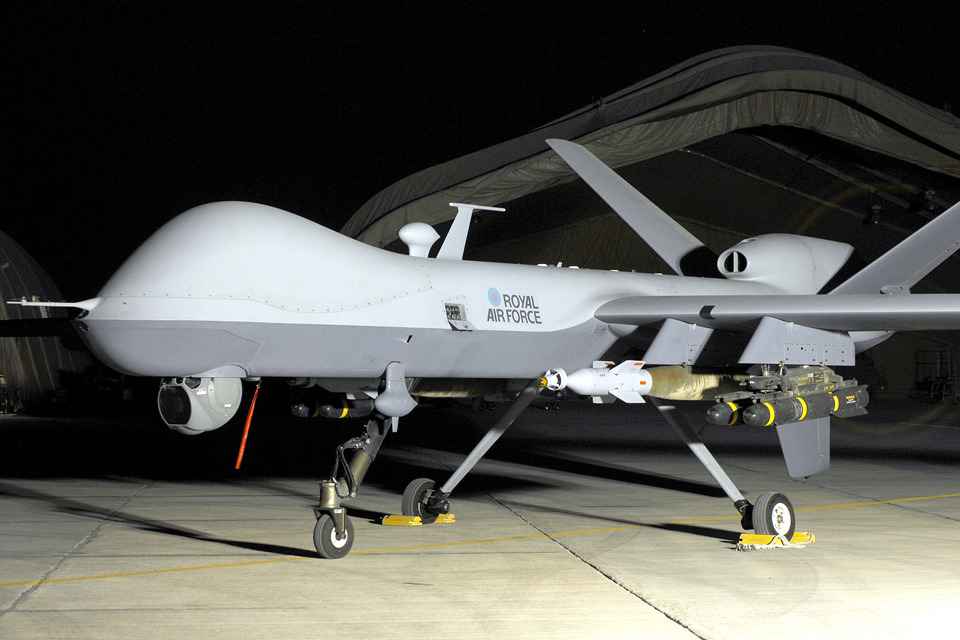
Today, major powers, like the UK, have integrated a diverse range of drones into their defence systems. The UK’s military drone arsenal includes the likes of the Watchkeeper WK450 for reconnaissance and the more formidable MQ-9 Reaper, designed for both surveillance and attack missions. While exact numbers remain classified, it’s evident that the number of drones in operation has surged, with big power countries investing heavily in these unmanned systems. Their popularity underscores not only the advances in drone technology but also the changing face of warfare in the digital age.Top of Form
In the landscape of modern warfare, drones have emerged as invaluable assets, revolutionising how battles are strategised and executed. Among their perceived benefits is the ability to significantly reduce human casualties. By deploying drones in high-risk zones, militaries can diminish the need for boots on the ground, ensuring the safety of their personnel. Coupled with this is their efficiency in precision targeting. Armed with cutting-edge surveillance technology, drones can monitor vast territories and identify threats with unparalleled accuracy. This allows for surgical strikes, minimising collateral damage. Their capability for prolonged surveillance further intensifies their utility. Unlike manned aircraft that are limited by human endurance, drones can hover over areas of interest for extended periods, providing continuous intelligence. Additionally, from an economic standpoint, drones often represent a more cost-effective option compared to traditional combat aircraft, both in terms of acquisition and operational costs. Their adaptability, ranging from reconnaissance missions to active combat roles, underscores their multifaceted utility in contemporary conflicts. In essence, the ascent of drones in modern military arsenals is a testament to their myriad benefits, reshaping the paradigms of warfare.
The proliferation of drones in modern warfare brings with it a host of ethical dilemmas. One of the most pressing is the potential for indiscriminate missile attacks. While drones are lauded for their precision, the reality is that they’re not infallible. Technical failures, misjudgments, or flawed intelligence can lead to unintended civilian casualties, muddying the moral waters of their use. Further complicating the issue is the challenge of holding powerful states accountable for potential drone misuse. For instance, without comprehensive international redress mechanisms, many nations remain beyond reproach. The fact that the U.S., possibly the most significant drone user, is not a signatory to the International Criminal Court (ICC) highlights the vast gaps in global accountability frameworks. Beyond the immediate battlefield implications, there are profound psychological concerns for drone operators. Sitting miles away, operators view the world through a digital lens, often evoking the aesthetics of a video game. This detachment can inadvertently dehumanise targets, reducing real people to mere pixels on a screen, and thus making the act of deploying deadly force more palatable. Over time, the mental toll of such operations can manifest in operators, juxtaposing the everyday familiarity of their tools—a laptop or a joystick—with the gravity of their actions. The blurring of lines between virtuality and reality, combined with the profound consequences of their decisions, raises urgent questions about the long-term psychological effects on these operators and the broader ethical ramifications of drone warfare.
The progression towards pixelated targets in drone warfare and the resultant dehumanisation eerily inch us closer to the dystopian visions depicted in Black Mirror’s “Men Against Fire”. In the episode, technology distorts the perception of the enemy into monstrous figures, abstracting the reality of war. This abstraction, whether through a neural implant or a drone’s screen, risks desensitising operators to the true gravity of their actions, making the once-unthinkable suddenly palatable.
The deployment of drones in conflict zones has created significant challenges in terms of compliance with international law and conventions. The principles of distinction and proportionality, core to the Geneva Conventions, mandate that combatants be distinguishable from civilians and that the harm caused to civilians and civilian property be proportional and not excessive in relation to the military advantage anticipated. However, drone strikes, especially in populated areas, often walk a thin line between tactical advantage and potential harm to civilians. Moreover, issues of sovereignty arise when drones are used in countries without the explicit consent of the governing body. This has brought forth debates on whether such actions violate the United Nations Charter’s prohibition on the use of force which states:
“All Members shall refrain in their international relations from the threat or use of force against the territorial integrity or political independence of any state, or in any other manner inconsistent with the Purposes of the United Nations.”
Article 3, common to all four Geneva Conventions, relates to the treatment of persons taking no active part in hostilities, ensuring that civilians and those hors de combat (out of the fight) due to detention, sickness, or wounds are treated humanely without any discrimination. The use of drones, if leading to indiscriminate civilian casualties, is likely to violate this provision.
The Fourth Geneva Convention specifically protects civilians, with its entire emphasis being on the protection of individuals not participating in hostilities. Article 27 mandates that protected persons are treated humanely at all times and are protected against acts of violence, threats, and insults, among other things. Though, Article 27 does go on to state:
“the Parties to the conflict may take such measures of control and security in regard to protected persons as may be necessary as a result of the war.”
Protocol I (relevant to international armed conflicts) elaborates on the protection of civilians. Article 51 prohibits indiscriminate attacks and ensures the protection of the civilian population and individual civilians from the dangers of military operations. It states that:
“The civilian population as such, as well as individual civilians, shall not be the object of attack. Acts or threats of violence the primary purpose of which is to spread terror among the civilian population are prohibited.
Civilians shall enjoy the protection afforded by this Section, unless and for such time as they take a direct part in hostilities.
Indiscriminate attacks are prohibited. Indiscriminate attacks are:
a) those which are not directed at a specific military objective;
b) those which employ a method or means of combat which cannot be directed at a specific military objective; or
c) those which employ a method or means of combat the effects of which cannot be limited as required by this Protocol;”
Article 57 of Protocol I outlines precautions in attack, requiring parties to do everything feasible to verify that objectives are neither civilians nor civilian objects and to take all feasible precautions to avoid, and in any event to minimise, incidental loss of civilian life.
One of the most contentious aspects of drone warfare is the development and utilisation of so-called ‘kill lists’. These lists, essentially databases of individuals deemed to be threats, authorise the targeted elimination of persons often without transparent criteria. The existence of these lists raises profound human rights questions. Primarily, the very act of pre-determining targets bypasses the principles of due process and judicial oversight, principles enshrined in many democratic systems. Individuals are condemned without the right to defend themselves, without a trial, and without any public justification, creating an atmosphere of unchecked power and potential misuse.
Rachel Alberstadt elucidates this very conundrum in her incisive analysis. She writes:
“States that employ drones to target individuals under the guise of the category of unlawful combatants usually do so under systematic elimination of these targets through the use of drones.”
Such systematic targeting by state policies, Alberstadt argues, aligns with:
“the criteria of Article 8 of the Rome Statute and results in the commission of war crimes.”
Furthermore, while the Geneva Conventions recognise civilians participating in armed conflicts without state authorisation as acting unlawfully, labeling them as “unlawful combatants” for targeted drone attacks effectively strips them of their civilian status. This is deeply concerning as it violates Article 8 (2) (a) (vi) which affords them the right to a fair trial. Additionally, Alberstadt points out that these policies might be construed as “intentional attacks against civilians” within the meaning of Article 8 (2) (b).
Beyond the immediate physical harm of drone strikes lies a more insidious impact: the psychological toll on communities living under the constant shadow of drone surveillance and warfare. In regions frequently targeted by drone strikes, entire generations have grown up with the omnipresent hum of drones overhead, resulting in a populace that’s perpetually “looking up”. The constant surveillance, paired with the ever-present threat of a sudden strike, has instilled profound fear, anxiety, and trauma in these communities. Children are conditioned to fear clear skies, often a precursor to drone activity. Societies are disrupted, with the norms of daily life upended by the hovering specter of remote warfare. This not only affects the mental well-being of individuals but can destabilise entire communities, sowing mistrust and fostering an environment of paranoia and fear.
Case Study 1: The 2013 Yemen Wedding Convoy Tragedy
In December 2013, a drone strike in Yemen’s al-Baitha province led to widespread international outrage. Acting on intelligence reports that identified a convoy as transporting al Qaeda militants, a U.S. drone targeted and struck the vehicles. Tragically, it was later revealed that the convoy was, in fact, a wedding party. As a result, 14 civilians were killed, 22 were injured, and among the deceased were two prominent tribal leaders of the province. A Yemeni national security official lamented, “This was a tragic mistake and comes at a very critical time. None of the killed was a wanted suspect by the Yemeni government.” Residents in the affected town of Radda called for an end to the drone strikes, with one eyewitness, Abdullah al-Kabra, despairingly noting that “More than 50 innocent civilians in our town have been killed by drones.”
Case Study 2: The 2022 Targeting of Abu Hamza al-Shuhail
A decade later, concerns over drone strikes are just as relevant with Britain’s targeted killing of Abu Hamza al-Shuhail. The RAF, in October 2022, carried out a “precision drone strike” in Syria, which resulted in the death of al-Shuhail, an arms dealer reportedly linked to the Islamic State. The Ministry of Defence (MoD) announced the attack over a month later, revealing that a Reaper drone, equipped with Hellfire missiles, had successfully targeted “a known terrorist in northern Syria.” Jennifer Gibson of Reprieve, a human rights charity, demanding transparency on the UK’s drone strike policies, stated this shows the UK are operating an extrajudicial targeting ‘kill list’ and asked “So what are its criteria for tracking and killing? How did it determine that this person was worthy of assassination? And why wasn’t parliament consulted or even informed?”
The trajectory of drone warfare is undeniably directed towards a future steeped in technological sophistication and greater automation. Advancements in drone technology are increasingly converging with artificial intelligence (AI), paving the way for autonomous drones. These drones, capable of executing missions with minimal human intervention, hold the promise—or threat—of reshaping the theatres of war. They can process vast amounts of data in real-time, make split-second decisions, and potentially reduce the risk of human error. However, this autonomy also raises grave ethical concerns, notably the responsibility and accountability for decisions made during combat by an AI.
As drone technology evolves, the international community faces the pressing task of adapting and enhancing regulatory frameworks. Given the implications of autonomous drones, there’s a burgeoning consensus on the need for a specific international convention—potentially under the auspices of the United Nations—that specifically addresses their use. Such a convention would aim to establish clear guidelines on the development, deployment, and use of autonomous drones in warfare, ensuring that fundamental human rights and principles of international law are upheld. In the face of rapidly advancing technology, the balance between leveraging innovation and ensuring ethical warfare will be a defining challenge of the coming decades.
The rise of drones in modern warfare is both a testament to technological advancement and a conundrum for ethics, law, and human rights. From their inception as surveillance vehicles to their modern-day capabilities of executing precision strikes, drones have revolutionised the dynamics of combat. Their advantages, while numerous, are shadowed by the profound human rights implications and the chilling potential of AI-infused autonomous operations. The international community finds itself at a crossroads, grappling with the urgency to delineate the bounds of drone warfare and safeguard the principles that underpin human dignity and justice. As we stand on the cusp of an era where warfare could be increasingly dominated by autonomous machines, it becomes imperative to continuously question, evaluate, and regulate their role, ensuring that humanity’s best interests are always at the forefront.

Avaia Williams – Founder
This blog was published on 15 August 2023
 Nightingale Rights Initiative