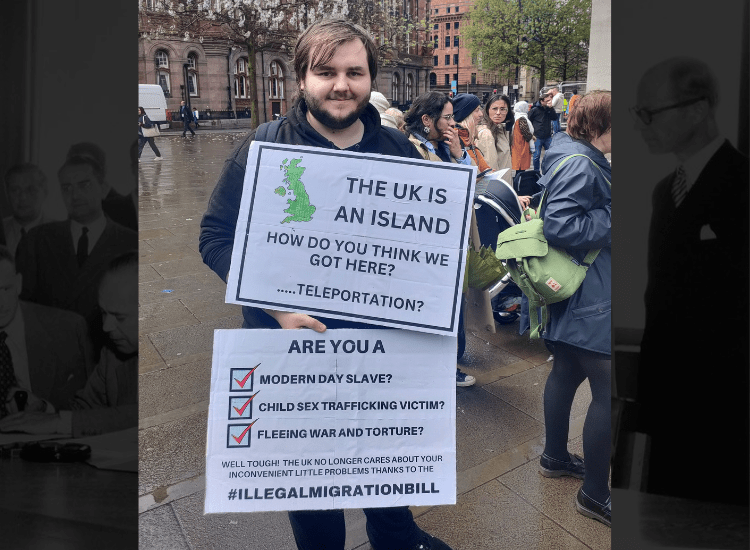
The recently passed Illegal Migration Act has ignited passionate debates and concerns regarding its implications on human rights. This legislation, aimed at addressing “unlawful migration”, particularly through unsafe and irregular routes, has raised questions about the potential violations of human rights and refugee protections under international law and treaties. In this blog post, I will delve into the key provisions of the act and assess its impact on human rights principles.
The Purpose and Provisions of the Illegal Migration Act
The primary goal of the Illegal Migration Act is to prevent and deter “unlawful migration” by enforcing the removal of individuals who breach immigration control in the UK. This includes those who enter the country irregularly or pass through a safe third country en route to the UK without proper permission. The Act places a legal duty on the Home Secretary to arrange for the removal of such individuals and their family members.
One of the controversial aspects of the Act is the proposal for a Rwanda migration partnership. However, the Court of Appeal has recently ruled this plan unlawful, raising concerns about Rwanda’s ability to fairly assess asylum requests from migrants. Despite the ruling, the government intends to appeal this decision at the Supreme Court. The Act also sets the stage for potential future migration partnerships, where asylum seekers arriving irregularly may be sent to other countries deemed “safe” by the UK government (a controversial enactment as it would be the government making such decisions about safety, something which has already presented numerous issues in the past with respect to Article 3, with these Memorandums of Understanding being ruled by courts and held by NGOs alike to be ineffective at safeguarding individuals) notwithstanding the issue that ‘legally’ claiming asylum in the UK is almost impossible for anybody needing to do so to actually do.
The Clash with Human Rights Obligations
Critics have expressed deep concerns that the Illegal Migration Act could potentially violate the UK’s human rights obligations. The United Nations High Commissioner for Human Rights and the UN High Commissioner for Refugees have both issued warnings, stating that the act contradicts international human rights and refugee law. The Office of the High Commissioner has stated that:
“The Bill denies access to protection in the UK for anyone falling within its scope – including unaccompanied and separated children – regardless of whether they are at risk of persecution, may have suffered human rights violations or whether they are survivors of human trafficking or modern-day slavery and may have other well-founded claims under international human rights and humanitarian law.”
This raises fears about potential violations of refugees’ rights and the principle of non-refoulement, which prohibits sending individuals to countries where they may face persecution or harm.
Helen O’Nions, an expert in human rights law at Nottingham Trent University, has pointed out that certain provisions in the Act rely on a “shaky interpretation” of the UN Refugee Convention of 1951. These interpretations could result in lengthy judicial debates on the Act’s alleged violation of human rights and refugee protection.
The European Convention on Human Rights Challenge
The Home Secretary, Suella Braverman, faced challenges in declaring the act’s provisions compatible with the European Convention on Human Rights (ECHR). Braverman acknowledged incompatibility with three provisions while still advocating for the bill’s progression. This has sparked discussions about the possibility of the UK withdrawing from the ECHR if the Act faces obstacles in the European Court of Human Rights (ECtHR).
When the Act was first laid before Parliament, Labour MP Clive Lewis stated that:
“Ensuring that compatibility is not only a basic moral requirement of the Government, but a practical necessity. The Government have said that this is critical legislation, and they are therefore presenting to the House clauses that they know will probably be ruled unlawful by a court of law.”
While supporters claim that the Act is necessary to address migration challenges, some Conservative backbenchers have suggested withdrawal from the ECHR if it delays the implementation of the Acts provisions. This raises further questions about the UK’s dedication to upholding human rights standards on a global scale.
Balancing Border Control and Human Rights
As the Illegal Migration Act takes effect, its implementation will be closely scrutinised for potential human rights violations. Striking a balance between border control measures and upholding human rights principles remains a complex challenge. Migration issues require comprehensive, humane solutions that prioritise the safety, dignity, and rights of all individuals, regardless of their legal status or mode of arrival.
The UK’s approach to migration and asylum must align with its international commitments to human rights and refugee protection. Navigating this path requires careful consideration and a willingness to engage with human rights experts, refugee organisations, and international bodies. An unlawful Illegal Migration Act will not only diminish the UKs status within the remit of international human rights, but it would also delay any actual and legitimate controls on migration.
Conclusion: A Critical Juncture for Human Rights
The Illegal Migration Act has placed the UK in the spotlight for protecting human rights and addressing immigration issues. As debates and discussions continue, it is essential to remember that human rights are universal and apply to all individuals, regardless of their background or circumstances – An important tenant of human rights, is that it is those who we often most vehemently disagree with, dislike, or would more easily disregard, that require and demand the most protections.
As the UK moves forward, striking a balance between border control measures and human rights protection will be a defining test of its commitment to upholding the principles of justice, compassion, and human dignity. However, as it currently stands, the government does not have a clean record when it comes down to recent human rights abuses and decisions, with significant misinformation being disseminated on the issue of migration and asylum, the public are more supporting than ever of stricter controls, including those deemed inhuman and degrading and ones obviously in breach of international human rights obligations.

Josephine Coulibaly – Writer
This blog was published on 28 July 2023
 Nightingale Rights Initiative