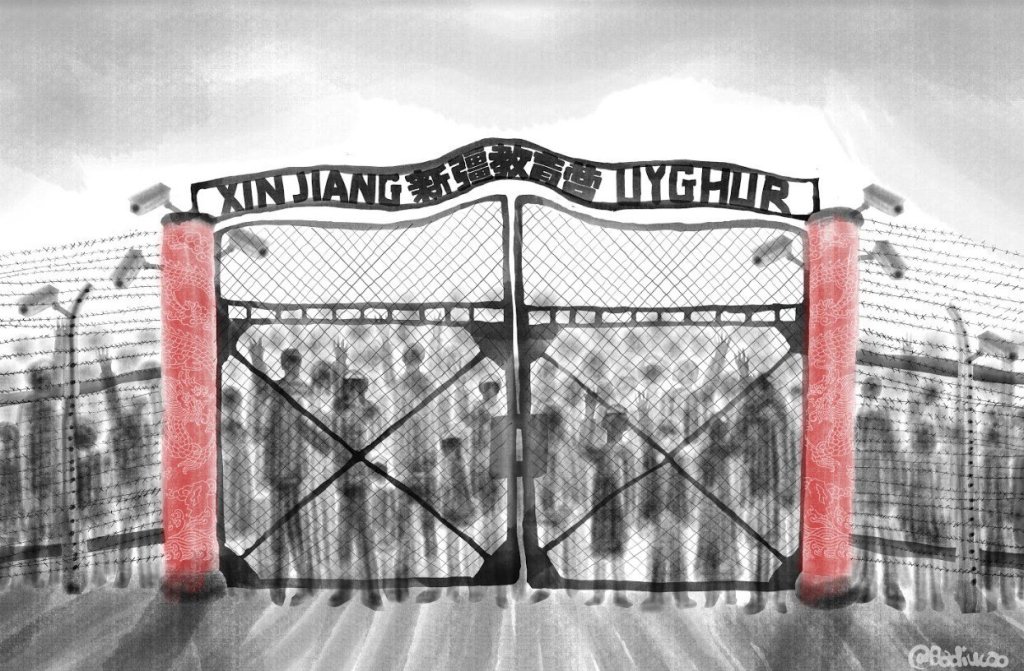
The Uyghur people are a majority muslim ethnic minority group located predominantly in northern China within the Xinjang Autonomous Region. Since around 2014, but very prominently from 2017 onwards, the Chinese Communist Party has conducted the largest scale campaign against an ethic minority group since World War 2, with estimates that over one million Uyghurs have been displaced into internment camps, colloquially called ‘re-education camps’ and ‘vocational training centres’ by the CCP.
The CCP and those in charge of these camps have committed numerous human rights violations in these, including initial arbitrary detention without any due legal process, forced labour and torture, sexual abuse and sterilisation, indoctrination, and religious and cultural suppression. Those not interned within such camps are subjected to heavy surveillance and hacking by the government.
The main argument made by the CCP is that the Uyghur are perpetrators of terrorism, extremism, and separatism. This ‘defence’ has received little support and evidence collected from numerous independent sources has shown that the scale of the issue is a deliberate and directed campaign to erase the Uyghur people through destroying their culture, religion, language, and identity.
Article 2 of the UN Convention on the Prevention and Punishment of the Crime of Genocide states that:
“…genocide means any of the following acts committed with intent to destroy, in whole or in part, a national, ethnical, racial or religious group, as such:
(a) Killing members of the group;
(b) Causing serious bodily or mental harm to members of the group;
(c) Deliberately inflicting on the group conditions of life calculated to bring about its physical destruction in whole or in part;
(d) Imposing measures intended to prevent births within the group;
(e) Forcibly transferring children of the group to another group.”
With international human rights NGO Genocide Watch declaring in 2020 that the situation in Xinjang was at stage 9 of a genocide emergency, the extermination of a group.
It is clear to see that there is not only a risk of a mass genocide occurring, rather, the genocide is already being perpetrated and has been for several years now. However, if this is the case, why are the international community doing nothing about this genocide considering the supposed lessons learned post-WWII? As pointed out by Omer Bartov:
‘Although legal norms against genocide have existed for over twenty years, necessary will to apply these norms is still lacking. Enforcement is frozen, not out of the law’s inadequacy as an instrument, but because of the political and moral paralysis of the national actors.’
Regrettably, what we continually see when genocides are in the spotlight is a lack of action by states and instead an international focus on the intricate details and minutia of these situations such as the definition of genocide and whether the situation is really a true ‘legal’ genocide. This takes away from the real issue that is the lives of millions of individuals currently being subjected to atrocities.
For most without an obsessive eye when it comes down to international law (which, to the benefit of any state committing a genocide, is most people) the act of genocide requires a specific intent to actually commit ‘genocide’, what this means is that where there is any other potential reason for the acts of genocide, outside the specific intent, then genocide cannot be charged, for example, and as backwards as it sounds, ethnic cleansing can be a defence to genocide. It is these practical and administrative elements of genocide are in fact the issue in respect of an international response, because, if genocide is not extremely black and white (which one would think it is and should be) then the type of response needed by supranational organisations may be argued as excessive or even acts of war.
One of the biggest complicating factors is that politics is an international affair, this has only been compounded in recent years. Nazi Germany is a very good example of this, whilst WWII started in 1939, the atrocities of the Nazi regime had been existing for several years, many of these atrocities were such that would meet the definition of genocide, with the first concentration camps being established 6-years before the outbreak of war and Hitler occupying two large states before the international community took decisive action. This lack of international response was during a time of less international co-reliability as there is now.
China, a country which many others are reliant upon for import and export agreements, a country which itself is a huge international player and superpower, and, perhaps most problematically, is one of the five countries with a permanent seat and veto power at the UN Security Council – The only international committee which would have the real power to take decisive action in Xinjang.
Dolkun Isa, a Xyghur refugee in Germany has spoken out about Europe’s silence:
“As a Uighur refugee who was granted asylum in Germany, I have great affection for my adopted homeland in Europe. I have lived in Germany for more than 20 years and raised a family here. The German government has, on multiple occasions, saved me from being deported to China, where I would certainly have been tortured, disappeared or even executed.
And yet, I watch with despair as Germany — and Europe at large — fails to take meaningful, concrete action to prevent a Uighur genocide.
For Uighurs living outside China, the situation is horrific: We have to watch from afar as our culture, language and identity are being erased. Most of us have been unable to contact our loved ones in more than three years, as they have disappeared into the camps or have been forced to cut off contact.
Europe must show that its commitment to human rights is not just empty rhetoric but defines who we are and determines our actions.”
But yet, not only have the international community not reacted, the ‘response’ has now shifted to overt ignorance of the situation in China. Even attempting to write this article, I struggled to find any meaningful statement from international leaders, the UN, the EU, national parliaments or judicial groups, or even a substantive conversation outside of government.
The last substantive action within the UK on this topic, was a recommendation by Parliament and the Foreign Affairs Committee to declare the issue a genocide. The Government, one which proudly stood against genocide in Europe and was a key drafter of the European Convention on Human Rights, responded to this recommendation that:
“…it is the long-standing policy of the British Government not to make determinations in relation to genocide.”
The only groups keeping the issue alive are NGOs and those who have been impacted by this genocide – As far as others are concerned, the matter has been discussed and decided upon, and the decision is to do nothing and allow the CCP to continue perpetrating this mass atrocity, because to ignore the situation makes it easier for the international community.
Because doing nothing is always easier, until it isn’t.
It is vital that we do not remain silent on this issue, you can keep aware of the atrocities being committed by following these organisations and projects:









Avaia Williams – Founder
This blog was published on 27 June 2023
 Nightingale Rights Initiative